Inversión
M€
años
plazo de la concesión
litros/segundo
Capacidad de la nueva planta
Motor de empleo y desarrollo local
El diseño de la planta responde a criterios de eficiencia operativa y de sostenibilidad, lo que permitirá reducir vertidos al mar, generar empleo local (más de 500 puestos durante su construcción y operación) y consolidar una infraestructura resiliente.
El proyecto contempla medidas de mitigación ambiental y territorial orientadas al reducir impactos durante el período de construcción y operación, junto con acciones permanentes de vinculación y atención comunitaria.
Asimismo, durante la ejecución de las obras y posterior operación de la planta se mantiene una estrategia de relacionamiento comunitario basada en el diálogo permanente, la entrega de información oportuna y canales de atención abiertos a la comunidad.
La iniciativa se enmarca en una estrategia de economía circular del agua, promoviendo la reutilización de recursos existentes y una gestión más sostenible del recurso hídrico.
Infraestructura avanzada con impacto regional
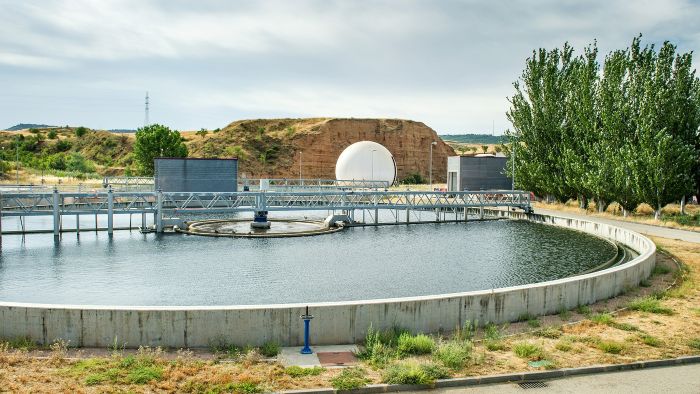
La actual planta entrega suministro de aguas residuales tratadas, suministro de agua ultrapura, y suministro de agua industrial. El futuro proyecto, con foco en agua de reúso destinada a la minería, mejorará sustancialmente los índices de sostenibilidad regional, además de generar más de 500 puestos de trabajo en la zona.
Está previsto que las aguas pretratadas se trasladen a lo largo de 16 kilómetros, hasta el sector de Salar del Carmen, incluyendo un tramo de 5,4 kilómetros en el área urbana que se ejecutará mediante micro tunelación. Además, se construirán 24 kilómetros adicionales hacia La Negra y otros 24 kilómetros hasta Mantos Blancos. La entrada en operación está proyectada para abril de 2028.

EDAR Guadalajara donde se ha realizado la prueba piloto.
Innovation to remove nitrogen in wastewater
Our Denitox project develops a technology that consumes less energy and less organic matter during nitrogen removal in high-load streams in wastewater.
12/05/2026
Nitrogen pollution in wastewater is an increasingly prevalent environmental challenge due to industrial, urban, and agricultural activities. Conventional nitrogen removal processes require intensive energy and a sufficient amount of organic matter that is not always available.
To improve this process and make it more efficient, we are innovating with the Denitox project, which we are developing together with the University of Granada.
"With Denitox, we managed to reduce nitrogen by up to 80% and save energy by up to 50%," explains Elena Campos, head of Technical Support for Sacyr Agua's Treatment Area.
The nitrogen present in surface water bodies can promote uncontrolled algae growth, which can lead to high fish mortality, as has happened in the Mar Menor.
More restrictive European directive
The new European Wastewater Treatment Directive (TARU) drastically reduces the limits of nitrogen in discharge, which in many cases implies a real technological challenge.
The runoff stream in plants with anaerobic sludge digestion can reach up to 20% of the total nitrogen load that reaches the plant and needs to be retreated after removal. Hence the importance of treating these return streams that have a high nitrogen content, but a low organic matter content.
With our Denitox technology we can achieve lower nitrogen emissions in the discharge, with high polluting potential, economic savings and the reduction of greenhouse gas emissions.
Pilot test
"We have carried out a pilot test in the Guadalajara treatment plant, which was applied to the return stream of the sludge line, which has a lot of nitrogen. If wastewater normally has between 60 and 80 mg per liter, that stream has 500-1,000 mg per liter. In this study, which was carried out with real water and variable conditions, an 80% reduction was achieved in a stable way," explains Elena.
"Now, the main challenge is to maintain these high efficiencies at room temperature and shorter hydraulic retention times. If we manage to bring it to an industrial scale, Denitox would be a competitive solution for wastewater treatment applicable in many treatment plants to meet nitrogen removal targets," concludes Elena Campos.
Before this test, a stopover was made in the laboratory at the University of Granada, with which we have developed this technology.
"We have optimized the operating conditions, but we need to scale up to a larger size and see how to control the conditions well.
International award in Saudi Arabia
Recently, the Denitox project has won the Global Prize for Innovation in Water (GPIW), organized by the Saudi Water Agency, in the Sustainable Water Production and Environmental Conservation category.
This category values the balance in water supply with the protection of the ecosystem and the reduction of emissions.
Markets
Canada
First construction contracts, with the horizon set in the infrastructure concessions market

Sacyr has established a strong presence in the Canadian market, recently highlighted by the concession for the new Ontario Science Centre Relocation project, secured through the Ontario Science Partners consortium under a DBFM model, in which it actively participates. This significant award builds upon the company's accumulated experience since commencing their construction activities in the country on February 2021.
Since then, Sacyr has successfully completed key projects demonstrating its capability and commitment in the region. These include the execution of two contracts of the Lakeshore East Corridor Expansion program in Toronto delivered in partnership with Ledcor, and, the design, construction, and financing of the Grandview Children’s Centre in Ajax, delivered in partnership with Amico Design-Build through the Children First Consortium.
Throughout the execution of all these projects, Sacyr and its partners maintain a strong commitment with local communities, environmental respect, and the application of the highest standards of sustainability and biodiversity.

In figures
+1Bn$
PROJECTS
Projects
4
contratos
awarded
6
KILOMETERS
transportation projects
400,000
sqf
ICI projects

Artificial Intelligence to Transform Sanitation Management
VIDIA project consists of a model trained to detect, classify, and geolocate incidents within sewerage networks.
09/04/2026
At Sacyr Water, we have a new system trained with artificial intelligence to detect damage in its collector networks.
"We believe that AI can achieve very low error rate functionality by training a model that learns from common defects detected by the human eye, such as cracks, fissures, and blockages in the sewerage network.
This Machine Learning model helps us reduce the error rate in detecting these common defects. Additionally, Artificial Intelligence has been implemented to interpret text and generate final reports", explains Miguel Cebrián, head of digital transformation at Sacyr Water.
VIDIA is an asset intelligence platform developed by Sacyr for critical sanitation infrastructure management.
This system transforms the traditional network inspection process into an automated, data-driven workflow. It doesn't just identify damage; it classifies it according to standardized typologies.
VIDIA utilizes generative artificial intelligence, advanced analytics, and integrated visualization, converting raw data into strategic information for decision-making. It is a tool that unifies everything: people, processes, and technology, providing a 360º view of the service.
"First, camera footage is captured, which can be done via a drone or a robot within the sewage network. Then, this video is fed into our VIDIA system which, thanks to ML technologies, identifies images, and with Generative AI, analyzes texts and automatically generates reports," states Miguel Cebrián.
Furthermore, VIDIA is integrated with the GIS system. This means all alerts are georeferenced on a city map, allowing for the prioritization of actions in strategic or sensitive areas.
This machine learning model, trained with generative AI, has been jointly developed by Sacyr Water's technical department and the company's IT department.
VIDIA differs from all similar systems in the water sector because it automates the entire workflow. It not only identifies damage but also contextualizes it: classifying it according to standardized typologies and precisely geolocating it within the collector.
VIDIA is positioned as a key tool to anticipate incidents, reduce operational costs, and ensure service continuity.
"Digital transformation in sewage network management is no longer an option, but a necessity. This tool transforms a traditionally slow and costly process into an automated, intelligent, and results-oriented workflow", concludes Cebrián.
SIS formalizes contract for the construction and concession of the new Novara Hospital (Italy)
- SIS, a consortium comprising Fininc and Sacyr, in partnership with Abp Nocivelli, will develop and manage this hospital infrastructure, which represents an investment of 525 million euros.
- The Novara complex will feature a hospital with 711 beds and a 24,000 sqm university building.
12/05/2026
SIS, a consortium formed by Sacyr and Fininc, in a joint venture with Abp Nocivelli, has signed the concession contract for the New City of Health and Science of Novara (Nuova Città della Salute e della Scienza di Novara) in Italy, a multifunctional complex featuring a new hospital and a university campus.
The project, awarded by Azienda Ospedaliera Universitaria Maggiore della Carita di Novara, a public entity of the Piedmont Region, encompasses the design, financing, construction, and 25-year maintenance of the hospital.
The contract outlines an investment exceeding €525 million and has a five-year construction timeline.
200,000 sqm of total building area
The new hospital will replace the existing facility, currently located near Novara's historic center and the university's faculty of medicine. The complex will be distributed across several buildings within a 325,000 sqm plot, which will also feature green areas. It will include a hospital, university facilities, a laboratory, a maternity and children’s ward, a central energy and technology plant, a university building, parking facilities, and a nursery.
The scope of the concession covers the maintenance of buildings and facilities, including the operation and management of water and sanitation systems, stormwater and wastewater disposal, electrical installations, and green areas, among other operations.
Reference center
This project is set to become a leading medical and scientific reference center in Northern Italy, strategically located to directly serve approximately 170,000 people and indirectly benefit over 500,000.
Key construction features of the project include:
- 711 beds
- 34 operating rooms
- 117,000 sqm of hospital space
- 24,000 sqm university building
- 16,000 sqm laboratory building
- 14,000 sqm maternity and children’s building
- 5,000 sqm central energy and technology building
- 25,000 sqm of parking facilities
- Heliport

Italy: a priority market
Italy is a priority market for Sacyr, where, through the SIS consortium, it holds concessions for the Turin Health, Research and Innovation Park, the Pedemontana-Veneta highway, the A-3 Naples-Pompeii-Salerno highway, the A-21 Turin-Piacenza highway (which also includes the Turin bypass and four other highway sections in the vicinity of the city), and the Via del Mare highway-A4 Jesolo link.
- Transport infrastructures
Lakeshore East Rail Corridor Expansion project in Canada

Pursuing our objective to grow in English-speaking markets, in March 2021, the Lakeshore East corridor became our first project in Canada.
Sacyr, in consortium with its local partner Ledcor, is carrying out packages B and C of the Lakeshore East rail corridor expansion and associated infrastructure for the Greater Toronto and Hamilton Metropolitan Area Transit Services operator.
- Canada
Km of track
million
bridges
The LSEW line is the oldest in the entire Toronto city transport network, and the second with the highest volume of traffic. The work includes the conditioning and preparation works for the installation of a future fourth track, which seeks to accomodate a 400% increase in the daily volume of passengers.
The works to be developed include the adaptation of approximately 6 km of slope for the track layout: the extension of the platform by 3.54 km, which will require the construction of six retaining walls (1.8 km), in addition to the extension of three railway bridges, embankments, a final layer of sub-ballast and drainage works.
We will also execute the 2.74 km extension with the construction of five retaining walls (822 m), extending a culvert to channel a stream under the railroad, grading and land clearing.
Some of the benefits consequence of this railway development will be lighter road traffic, the reduction of greenhouse gas emissions and less fuel consumption, as well as the improvement of the quality of life of users and faster travel times.
- Canada
Vídeo
III Health & Safety Culture Awards