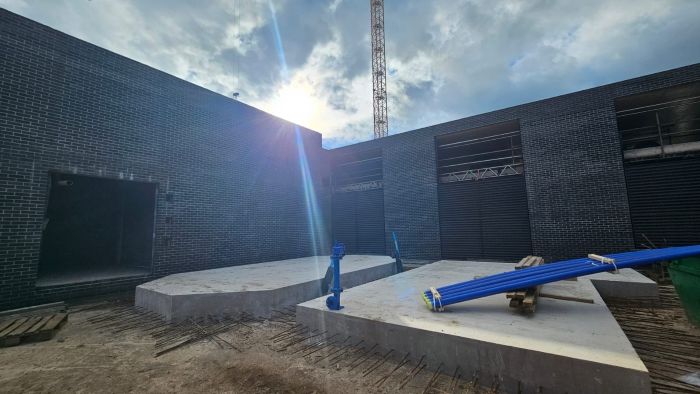
We’re incorporating a pioneering solution into the construction of the new Velindre Cancer Center in Cardiff (Wales, United Kingdom): bricks made from construction waste.
In 2023, the Scottish firm Kenoteq won our open innovation program, Sacyr iChallenges. The collaboration between the two companies led to the creation of the K-Briq brick, which is now helping Velindre become one of the most sustainable hospitals in the United Kingdom.
“This technology, developed to promote the circular economy, has found a real-world application in a flagship Sacyr project,” explains Vincenzo Nigro, Technical Manager at the Velindre Cancer Center.
The hospital will incorporate approximately 1,000 m² of these low-carbon-footprint bricks, equivalent to about 60,000 units and more than 151 metric tons of material.

“What makes K-Briq particularly innovative is its composition. These bricks are made from more than 90% recycled construction and demolition waste, which eliminates the need for new raw materials,” adds Vincenzo.
Its production process eliminates the traditional firing of ceramic bricks, drastically reducing the energy required for manufacturing and bringing its carbon footprint to less than 5% of that of a conventional brick.
Their performance has been verified through tests conducted in accordance with various British and European standards and is backed by BBA Agrément Certificate 25/7367.

These tests certify aspects such as their mechanical strength, fire performance, durability, and resistance to moisture, confirming their suitability for use in construction. Furthermore, the bricks maintain their performance even after freeze-thaw cycles, a critical factor for their use in the United Kingdom.
At the Velindre Cancer Center, the bricks will be installed in the Service Yard, the utilities area, and the Facility Management area. Their use will have a significant impact on the project’s overall sustainability.
“Examples like this demonstrate that open innovation is a key tool for accelerating the sustainable transformation of the construction industry. It allows us to identify, validate, and incorporate solutions that reduce the environmental impact of construction without compromising technical performance,” concludes Vincenzo.