MARÍA GÓMEZ BRAVO | Tungsteno
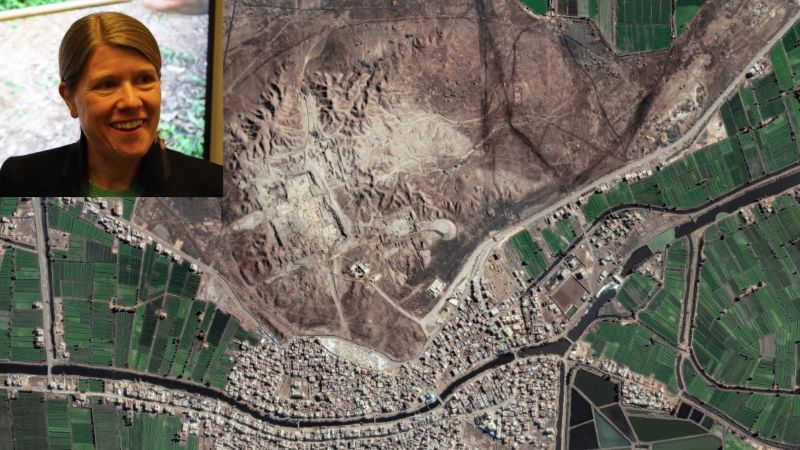
In the Nile Delta, many ancient Egyptian cities disappeared centuries ago beneath layers of sediment, farmland and modern development. From ground level, they are almost impossible to identify. Seen from space, however, some leave faint traces in the form of geometric lines, tonal variations or slight differences in soil moisture. Sarah Parcak, an Egyptologist and professor at the University of Alabama at Birmingham, has turned these subtle signals into a tool for locating potential archaeological sites without the need for prior excavation.
In the early 2010s, she participated in a number of projects focusing on ancient Egyptian settlements. In the Nile Delta, the contrast between cultivated land and desert areas makes it easier to detect small changes in the terrain that are invisible to the naked eye. Satellite imagery revealed geometric lines and subtle surface variations that corresponded to buried ancient structures. These were not visible ruins or cities emerging from the sand, but rather physical traces that the landscape had preserved for centuries.
Parcak began working with this type of imagery during her doctoral research at the University of Cambridge. Unlike conventional photographs, multispectral images capture information that the human eye cannot perceive. Her aim was to locate tells—mounds formed by successive layers of human occupation—and possible buried structures across the Middle East based on these minute alterations detected through infrared sensors. “To try to map the past, I have to look at it in a different way,” Parcak has said, summarising a central idea that runs through her research: landscapes preserve physical evidence of the people who inhabited them centuries ago.
Sarah Parcak explains how space archaeology uses satellite imagery to locate traces of ancient civilisations hidden beneath the ground. Credit: TED.
A new way of interpreting the landscape
The use of aerial imagery to study the terrain was not entirely new. After the First World War, photographs taken from military aircraft began to reveal ancient shapes and structures that were difficult to identify from the ground. Decades later, satellites from NASA’s Landsat programme made it possible to extend this observation to vast swathes of the planet and analyse how landscapes changed over time. But the real breakthrough lies not in conventional photography, but in understanding how buried structures affect soil, vegetation and temperature.
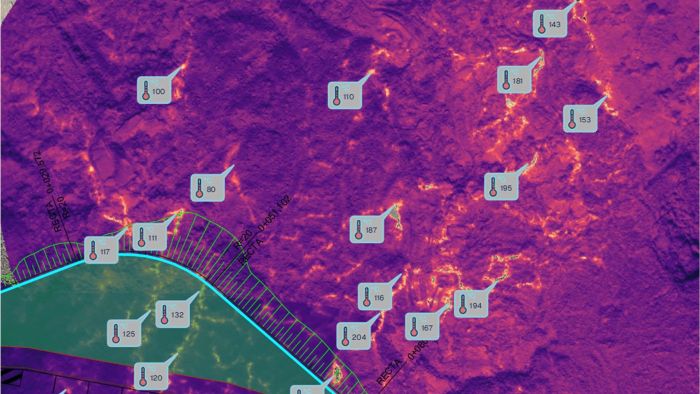
For example, a buried wall can alter the moisture content of the soil above it. Similarly, an adobe structure can change soil compaction and affect vegetation growth. Some constructions also generate temperature differences that become detectable at specific times of day. By analysing these subtle variations, researchers can identify areas with archaeological potential, which must then be investigated on the ground. Parcak herself insists that these tools do not replace excavation, but rather help to guide and focus archaeological fieldwork.
From isolated sites to landscape-scale analysis
The ability to analyse entire regions rather than just specific sites is one of the main contributions of this methodology. One of the best-known examples is the work carried out at Tanis, an ancient Egyptian city located in the northeastern Nile Delta. Although the site had been known for decades, satellite imagery helped researchers reconstruct parts of its buried urban layout, revealing streets, structures and occupation zones hidden beneath sediment and modern agricultural land.
The value of this type of research lies in understanding how ancient urban and agricultural landscapes were organised on a large scale. Parcak applied this same approach to the study of the funerary complexes and tombs of El-Lisht, one of the principal centres of Egypt’s Middle Kingdom, as well as to Petra in Jordan. There, she identified a monumental structure that had gone unnoticed despite Petra being one of the most intensively studied archaeological sites in the world.
This shift in perspective has influenced other projects around the world. In Guatemala, the Pacunam LiDAR Initiative, involving the Polytechnic University of Valencia in Spain and Tulane University in the US, identified thousands of Maya structures concealed beneath the dense jungle canopy, including elevated roadways and agricultural terraces.
In Cambodia, a combination of satellite imagery, radar, and large-scale LiDAR surveys confirmed the existence of an extensive urban network beneath the forests surrounding Angkor Wat. In the United Kingdom, the Stonehenge Hidden Landscapes project used ground-penetrating radar and remote sensing to detect prehistoric monuments buried around the megalithic complex.
In each of these cases, archaeology has moved beyond the study of isolated monuments to examine entire landscapes and the relationships between settlements, infrastructure, and the natural environment.