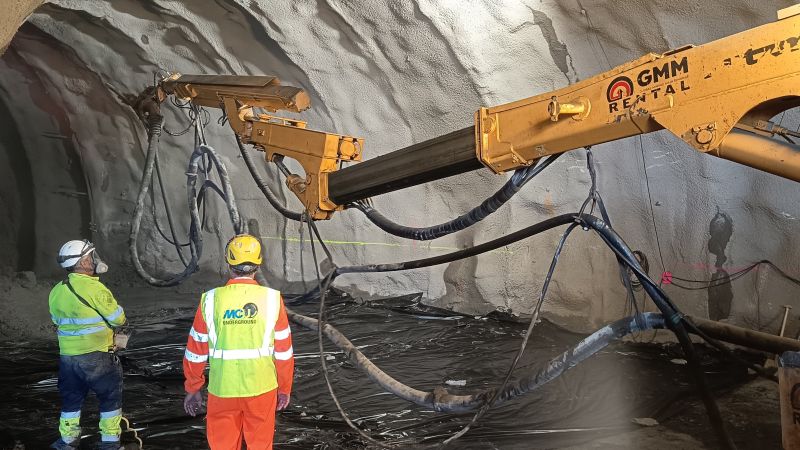
Shotcrete is essential in tunnel construction: it stabilizes excavations and helps ensure safe working conditions.
However, not all material adheres to tunnel surfaces. Some falls to the ground, creating waste and material losses, increasing cleanup work and adding to environmental impact. Under normal conditions, waste can exceed 15% of concrete used in the process.
At Sacyr Engineering and Infrastructure, we have launched ECO-Shot, a pilot project during construction of Line 5 of Bilbao Metro to address this issue. The project assessed performance of MC-Montan Shotsol, an additive designed to improve concrete cohesion and significantly reduce rebound. We had previously used this additive on a project in Colombia.
“The trial was carried out under real site conditions, comparing two identical mixes that differed only in the additive used,” explains Pablo García del Campo, technical director at Cavosa. “To ensure reliable results, all application factors were kept constant: same spraying robot, same operator, same working environment and same sprayed volume,” he adds.

In trials, rebound material fell from 12.5% to 7.6%, a reduction of nearly 40%.
“During tests, the mix showed more stable behavior and more continuous pumping, reducing adjustments needed during application. This led to a smoother process, less equipment wear and improved productivity,” says García del Campo.
The most significant impact is environmental. Because less concrete is needed to achieve the same result, cement consumption falls. Cement is one of construction’s highest-carbon materials.
According to our estimates, this improvement could avoid around 253 metric tons of CO₂ equivalent on the metro works, thanks to lower material consumption and fewer transport movements linked to the project.
Initiatives like this help us keep moving toward more efficient, competitive and sustainable construction. They also show that innovation applied on site can deliver economic, operational and environmental benefits.