MARÍA GÓMEZ BRAVO | Tungsteno
In March 2001, television viewers around the world watched the destruction of the Afghan Buddhas of Bamiyan. For weeks, explosions ordered by the Taliban regime gradually reduced the two ancient sculptures to rubble. Twenty-five years later, those images have become a symbol of the deliberate destruction of cultural heritage and continue to fuel the debate about what happens when monumental works—designed to last for centuries—disappear.
Long before Bamiyan, earthquakes, fires, wars, the passage of time, and the reuse of their materials caused some of the colossal monuments of antiquity to vanish. Of many of these magnificent sculptures, only traces remain: the texts that described them, the sites where they once stood, scattered fragments, or the imprints they left on the landscape. Today, these traces are complemented by new tools that allow us to reconstruct and study monuments that no longer exist physically.
A Colossus in Constant Reconstruction
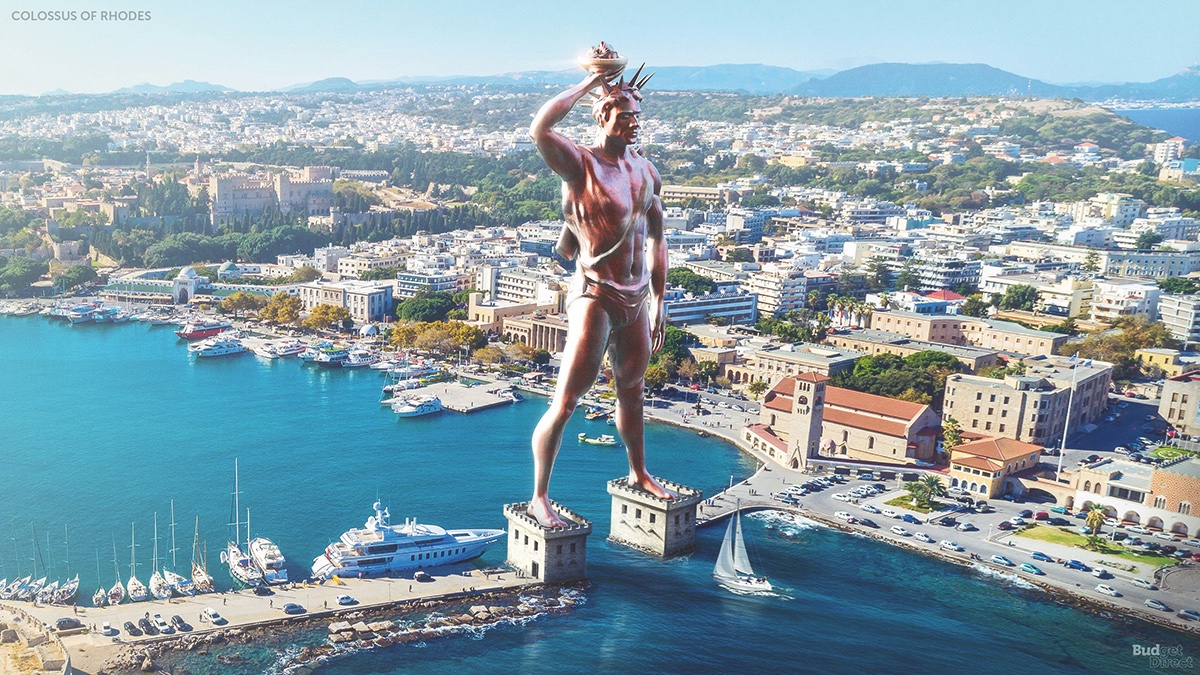
Few sculptures have inspired as much literature while leaving us with so little certainty as the Colossus of Rhodes. The image of the giant towering over the entrance to the harbor is part of the collective imagination, although we do not know whether it actually stood there. This interpretation emerged centuries after the bronze statue disappeared and ultimately shaped the way we still imagine the colossal figure dedicated to the god Helios today.
Today we know that the Colossus was erected between 295 and 283 BC to commemorate Rhodes’ victory following the siege led by Demetrius Poliorcetes and that it stood approximately 34 meters tall. Nathan Badoud, author of The Colossus of Rhodes: Archeology of a Lost Wonder, suggests that it may have been located near the present-day Palace of the Grand Master. There is also broad consensus on the cause of its destruction: an earthquake toppled it barely half a century after its construction.
Beyond these facts, much remains uncertain. No identified fragments of the statue have survived, and ancient sources offer only sparse descriptions. Archaeologists and historians have reviewed the topography of ancient Rhodes, classical texts, and the political context in which it was erected to try to determine where it stood, what it looked like, and what it meant to a city that had by then become one of the great powers of the eastern Mediterranean.

Research drawing on classical literature, combined with disciplines such as topography and engineering, challenges the image and location traditionally associated with the Colossus. Photo: Culture Club/Getty Images.
Engineering also plays an important role in this research. Knowledge of Hellenistic metallurgy, materials, and the structural behavior of bronze makes it possible to assess the feasibility of the various hypotheses regarding its construction. Ancient sources, including the texts of Pliny the Elder, remain fundamental, but they are no longer the only tools available for attempting to reconstruct a colossus that disappeared more than two thousand years ago.
Reconstructing from the Original Site
We do not know for certain when or how the Statue of Zeus at Olympia disappeared. We do know that around 430 BC, a monumental figure of Zeus presided over the temple dedicated to him at the Greek sanctuary in the Peloponnese. The building had been erected a few decades earlier, in the first half of the 5th century BC, and its pediments and metopes were decorated with an extensive sculptural ensemble. Opposite the temple, outside the sacred precinct of the Altis, stood the workshop where Phidias worked—the sculptor responsible for the monumental depiction of Zeus.
Excavations at the site uncovered terracotta molds, ivory fragments, and materials used for glassworking. A small cup bearing the inscription Pheidiou eimi (“I belong to Phidias”) was also found. The chronology of the finds dates activity in the building to the third quarter of the 5th century BC, coinciding with the period when the sculpture—one of the Seven Wonders of the Ancient World—was constructed.

The materials used in Phidias’s great sculpture of Zeus and the methods used to make some of its components are known from molds found at his workshop,outside the sacred precinct of the Altis. Credit: Hulton Archive/Getty Images.
The Statue of Zeus was a chryselephantine sculpture of extraordinary dimensions. Art historian Judith M. Barringer estimates its height at around 13.5 meters, a scale that required the figure to be constructed using an internal framework—likely made of wood—over which various materials were applied, primarily ivory for the skin and gold for the garments. The molds found in the workshop allow us to study how some of these components were made, although we still do not know precisely how the entire figure was assembled.
The combination of materials also affected its preservation. Ivory and wood are sensitive to changes in humidity. When the Greek traveler and geographer Pausanias visited Olympia in the 2nd century CE, he noted the presence of olive oil in a depression in front of the statue. This has been interpreted as a possible measure to protect the ivory from environmental conditions, although later research also suggests an optical function: the surface may have helped reflect light onto the figure. Both interpretations remain possible.
The Images That Survived the Buddhas
After the explosions, the two large niches at Bamiyan were left virtually empty, and the remains of the sculptures lay scattered at their feet. To study them, researchers had access to something that never existed in the case of the Colossus of Rhodes or the Statue of Zeus at Olympia: photographs taken before their destruction.

The world’s tallest standing Buddha statue, located in the province of Bamiyan, was destroyed by explosions ordered by the Taliban regime in 2001. Credit: JEAN-CLAUDE CHAPON/AFP/GETTY.
Just three years later, Armin Grün, Fabio Remondino, and Li Zhang of ETH Zurich drew on three collections of images from before 2001 to digitally reconstruct the Great Buddha. The study, published in The Photogrammetric Record, combined photographs taken by visitors with others taken specifically for measurement purposes. Photogrammetry made it possible to reconstruct its shape and dimensions and generate a three-dimensional model.
Digital techniques were also applied to the cliff face. Laser scanning and photogrammetry were used to document the niches and remains and obtain an accurate record of their condition. Years later, some projects incorporated these data into virtual environments to study different conservation and restoration measures before undertaking any work on the site.
In 2017, a study published in PLOS ONE analyzed the layers of paint adhering to some fragments to reconstruct part of the history of their decoration. The analyses identified egg proteins used as a binder in the original layers and cow’s and goat’s milk in later repaintings, making it possible to distinguish between different stages and materials used on the Buddhas over time.
Reconstructing or Preserving the Absence
Digital technologies have made it possible to reconstruct the appearance of the Buddhas with a precision that was unthinkable a few decades ago. But turning those models into a physical reconstruction raises a different debate. Twenty-five years after their destruction, the future of the Bamiyan niches remains unresolved.
Proposals have ranged from leaving them empty to partially or fully reconstructing some of the figures. UNESCO and experts who have worked on the site have spent years analyzing the various possibilities. It is not merely a matter of determining what can be reconstructed: it is necessary to assess the stability of the cliff, the original fragments that could be reused, the authenticity of any potential intervention, and its significance for the communities connected to the valley.

The possible reconstruction of the Bamiyan Buddhas, destroyed by the Taliban regime in 2001, has kept alive the debate about how much of their absence should be preserved. Credit: KAMRAN SHAFAYEE/AFP via Getty Images.
Added to these questions is the historical value of the destruction itself. The 2001 explosions forever altered the site, and their traces are now part of Bamiyan’s recent history. For this reason, one proposal is to leave at least one of the niches empty as a testament to what happened, while others advocate restoring, to varying degrees, the presence of the Buddhas.
Tungsteno is a journalistic laboratory that explores the essence of innovation.