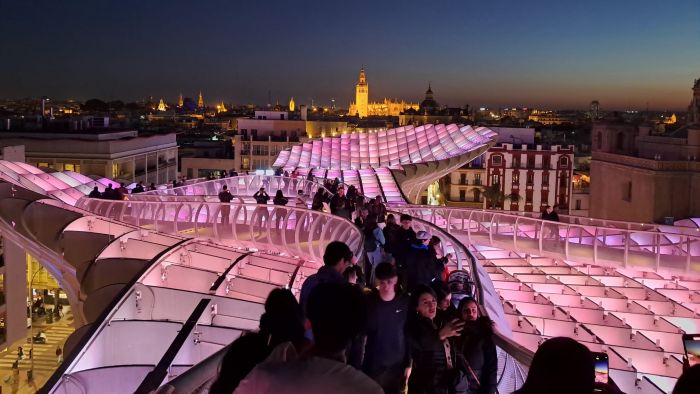
Superblocks are making their way into our urban layouts. They go beyond the traditional concept of blocks to configure larger spaces in which traffic decreases and improves the integration of leisure, green areas, and residential buildings.
"Urban superblocks reorganize the urban fabric to prioritize pedestrians," says Gema Ortiz, Innovation project manager at Sacyr and head of Sustain, a superblock project in the center of Seville (Spain).
Our site, Las Setas de Sevilla, participates in Sustain together with a consortium of companies and entities. In a city as touristy as the Andalusian capital, this project aims to improve the experience of visitors and citizens of Seville.
"We seek a positive social impact and we rely on cutting-edge technologies, such as digital twins and artificial intelligence," explains Leticia Franco, coordinator of Las Setas de Sevilla.
Sustain is funded with €1.8 million by the "Science and Innovation Missions 2024" Call, promoted by the Center for Technological Development and Innovation, with Next Generation funds from the European Union, within the Recovery, Transformation and Resilience Plan.
It is led by Inycom, and together with Las Setas de Sevilla, Cemosa, Buchanan and Simetría Innovación are participating.
Sustain addresses digitalization, sustainability, resilience and social impact in urban environments. "We promote a significant reduction in the carbon footprint, an improvement in energy efficiency and environmental quality and an optimization of urban mobility. In short, the creation of healthier and more sustainable environments," explains Gema Ortiz.
To achieve these objectives, an integrated management platform is being developed that, through the use of digital twins and artificial intelligence algorithms, allows the design and optimization of superblocks in all their constituent elements: building, mobility and redevelopment.
The platform simulates behaviors and makes decisions based on data from different sources, in order to reduce risks, improve participation, and continuously adapt the design to maximize social, environmental, and economic benefits.
Thanks to this technology, Las Setas de Sevilla will be able to improve infrastructure management, security, user experience and maintenance.
"Together with the ITA Technology Center, we have developed a digital twin that will allow us to identify behavioral patterns in Las Setas visitors through the use of various sources, cameras and mobile data, among others. In addition, we will predict behavior in future scenarios and, based on this, we will be able to deploy our management strategy", summarizes Leticia Franco.