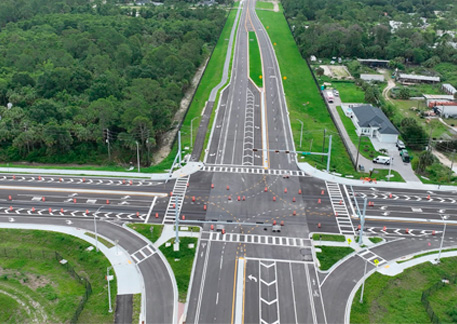
The Pedemontana-Veneta toll road is one of the most important infrastructure projects in Italy. It is also one of the biggest projects in our portfolio there, with a planned investment of 2.6 billion euros.
The company Superstrada Pedemontana Veneta is in charge of designing, building, financing, running, and maintaining the toll road for a period of 39 years following completion of construction.
This project involved building 162 km of road. 94 km of the main road that will link 34 municipalities and the industrial area of Vicenza and Treviso. The remaining 68 km are for secondary access roads. This road will also include two tunnels - the Malo tunnel (6 km) and the S. Urbano tunnel (1.5 km) - and eight viaducts.
The infrastructure guarantees the high demand for mobility in the most industrialized area of the Veneto region, with close to half a million companies and 4.9 million inhabitants.
- P3 Projects
The Pedemontana-Veneta Toll Road: a strategic asset in Italy
Italy Pedemontana Veneta
Sacyr Concessions
- Transport infrastructure
- Sacyr Concessions
- Autopistas
- Italy
BILLION EUROS
Total investment in the project
KILOMETERS
Newly built road
KILOMETERS
Tunnels
Sustainable project
The highway’s environmental impact is minimal, given that 70% of the route runs through a trench or tunnel. It presents no visual disruption or noise, nor does it constitute a barrier since it is virtually invisible from preexisting roads, services, canals, and wildlife areas.
The project was designed and built using the latest innovations in safety, technology, and sustainability, including Sacyr’s Iohnic lighting system and sound-absorbing, antiaquaplaning, photocatalytic asphalt (which attracts contaminating particles and, in conjunction with light, oxidizes nitrates and carbonates).
In addition, the colors of the trench walls vary according to municipality, making it easier for drivers to orient themselves. Pedemontana has transparent noise barriers so as not to reduce the visibility or illumination of the platform.
Pedemontana-Veneta (Italy)
- Transport infrastructure
- Sacyr Concessions
- Autopistas
- Italy
- Infrastructures
Torre Sacyr: we are changing the Madrid skyline

Torre Sacyr
Infrastructures
07/09/2020
At a staggering 236 meters, it is the third tallest skyscraper in Spain and one of the 200 tallest buildings in the world. The Torre Sacyr building, located in the Cuatro Torres Business Area in Madrid, was designed and built in accordance with stringent sustainability and eco-efficiency criteria. Its ventilated double-skin facade allows for major energy savings to be made and facilitates maintenance tasks without interfering with the work going on in the office spaces.
The building - standing 64 storeys high, with 6 below ground and 58 above - has two uses: hotel (up to the 34th floor) and offices. This characteristic posed additional challenges during the construction process, since different installations were required on different floors depending on their use (electricity, gas, telecomms, fire safety and sanitation, among other aspects).
- Sacyr Infrastructures
- Edification
- Spain
METERS
Total building height
MILLION EUROS
Investment in the project
SQUARE METERS
Built area
- Sacyr Infrastructures
- Edification
- Spain
Esta icónica estructura de 18 plantas fue el hogar del antiguo bloque de hospitaliación.
La demolición tiene un rasgo añadido de complejidad técnica, ya que entregamos el nuevo edificio en 2024 y está muy cerca de la antigua torre. Para llevar a cabo el desmantelamiento del edificio empleamos una pluma de 62 metros.
Sustainable Energy Efficiency
The building will be powered by a 300,000-W solar electricity production facility (nominal power of the inverter), which will require 756 400-Wp solar panels on the roof, designed to dissipate heat in a faster, fully compact way. This installation will connect directly to the main low-voltage panel in order for the hospital to consume the energy generated.
Ethics Channel
The Ethics Channel is a corporate tool intended to facilitate the secure and confidential formulation, by employees or by third parties, of any query regarding the scope and applicability of the Code of Ethics and Conduct and, in general, of the Group's Regulatory Compliance Model, as well as to report situations of infringement of this Code of Ethics and Conduct, of the Compliance Model in general or of the applicable internal or external regulations, especially potential conducts related to corruption, anticompetition or constitutive of criminal offence that can be detected.
Among other behaviors, you can communicate cases of fraud, corruption, anti-competitive practices or violations in the prevention of money laundering.
According to our Harassment Prevention and Complaints Management Protocol reflects, we are committed to prevention and correct action in the event of possible sexual, workplace and gender-based harassment at work. For this reason, we have this Ethics Channel, through which you can report possible situations of harassment or discriminatory acts in our workplaces.
The Regulatory Compliance Unit is the body responsible for the operation of the Ethics Channel, as well as for the analysis of the complaints and queries formulated through this channel, safeguarding the confidentiality and rights of those affected and ensuring the protection of the complainant.
Basic privacy information
The Sacyr S.A. Board of Directors is responsible for the processing of your personal data within the framework of the comprehensive management of the Internal Information System and the Ethics Channel that you will access.
We will process your personal data with the sole purpose of investigating the facts communicated and adopting the appropriate measures within the framework of current legislation in this regard. If you prefer, you can send us an anonymous complaint through our Ethics Channel, which will be investigated in accordance with the provisions of Law 2/2023, of February 20th, regulating the protection of persons who report breaches of Union Law.
Likewise, we inform you that we will obtain the data that you provide us through the Ethics Channel or through third parties in the event of public disclosure, and if applicable, we will process the information contained in said disclosure.
You can exercise your rights of access, rectification, deletion, opposition, purpose limitation and portability with respect to the personal data you have provided by writing an email to protecciondedatos@sacyr.com.
You can contact our Data Protection Officer at dpo@sacyr.com or obtain additional information on how we process your data in the Sacyr Ethics Channel here
General Policy of the Internal Information System - 226 Kb
Política Geral do Sistema Interno de Informaçao - 226 Kb
Protocol for prevention and action in cases of harrassment and discriminatory acts - 175 Kb
Protocolo para a prevenção e atuação em casos de assédio e atos discriminatório - 177 Kb
- Hydraulic infrastructures
Expansion works of the Panama Canal: the largest engineering piece of work in the 21st century
The expansion works on the Panama Canal have posed an engineering challenge for a long time. At Sacyr, we are passionate about challenges, and in 2016 we successfully finished building the third set of locks, a new maritime transit route that runs parallel to the pre-existing locks.
Watch all our videos on the Stories of the Canal and the Panama Canal
- Sacyr Infrastructures
- Canal de Panamá
- Tercer Juego de Esclusas
- Panamá
KILOMETERS
Two two-kilometer platforms on the Atlantic and Pacific coasts
MILLION EUROS
Of total investment
PEOPLE
Involved in the project
Construction for the future
The expansion of the Panama Canal is a colossal work from an economic standpoint as well. The Canal is a strategic route for international trade and at 6% of Panama’s GDP, is the country’s principal economic activity. With a total investment of almost 4,000 million euros, this project has yielded Panama up to 2,500 million euros per year and has generated 180 direct employment positions.

Innovation at the service of engineering
We designed a unique kind of concrete in order to overcome the challenges that the area posed from the technical, orographic, geological, and climatic standpoints. We improved the formula to guarantee a lifecycle of at least 100 years. Chemical proof, this concrete can stand inner temperatures of up to 70ºC. We also worked on a pioneer earthquake protocol response model, designing a structure ready to respond to two kinds of seismic levels.
"The Panama Canal is one of the most emblematic civil construction works in history. To lead its expansion has been a great satisfaction to Sacyr”
Manuel Manrique, President and CEO of Sacyr

Manuel Manrique, President and CEO of Sacyr
An efficient and sustainable project
Right from the start, the expansion of the Canal has taken the environmental aspects into account. As the new set of locks is quicker to fill and empty, they consume 7% less water. The sluicegates have nine deposits that allow reusing water and save up to 60% of this precious resource.
As for its atmospheric impact, we estimate that the third set of locks will help reduce more than 160 million tons of CO2 from the shipping sector in the next ten years.
We also care about preserving the biodiversity of Gatun Lake, which the Canal traverses. Before beginning construction works, environmental specialists rescued and relocated all local fauna (such as turtles, caimans, sloths, and boa constrictors) to the adjacent San Lorenzo park. Furthermore, we reforested a surface area of 2,800 ha, planted close to 6 million trees, and carried out training, informative, and follow-up programs about the project with the local communities.
Rescue and relocation of local flora and fauna species
- 4,500 rescued and relocated specimens
- 200 protected species
- 2800 ha of reforested surface
- 5,8 million trees planted
Brief history of the Panama Canal
The Spanish were the first to promote the creation of a maritime route in Panama. In the 15th century, they opened the Camino de Cruces, connecting the Atlantic and Pacific coasts for the first time. In the 19th century, several expeditions took place in the isthmus, and the transoceanic railway was inaugurated, which was pivotal to the later construction of the Canal. In the early 20th century, the United States started looking into the Panama transoceanic route with a keen eye. A few days after the country obtained its independence, they won the concession for constructing the Canal from the French company Compagnie Universelle du Canal interocéanique de Panama. Construction works started in 1904 and ended in August 1914, going down in the history of engineering.
- Sacyr Infrastructures
- Canal de Panamá
- Tercer Juego de Esclusas
- Panamá
- Transport infrastructures
Calcasieu River Bridge, a huge P3 project in the U.S.
Calcasieu River Bridge_I10
Sacyr Concesiones
12/02/2024
We improve local and interstate connectivity in Louisiana with a new bridge over Calcasieu River at the Interstate 10, which will replace the current bridge, built in the 1950s.
This Louisiana Department of Transportation and Development (LA DOTD) project comprises the design, construction, finance, operation, and maintenance of this 5.5-mile (9 km) infrastructure for a 50-year term.
Contract calls for a $2.1 billion expected investment (€ 1.9 billion).
We’ll develop this project as Calcasieu Bridge Partners (CBP), comprising Sacyr, Acciona and Plenary Americas.
This is a highly anticipated project for road users that will meet the highest standards.
This project is the largest to date in the history of the State of Louisiana, and one of the was one of the largest infrastructure contracts commissioned in North America in 2023.
This is our first transportation infrastructure P3 contract in the US, and a huge boost to the company’s growth strategy in the U.S.
- USA
INVESTMENT
Kilometers
VEHICLES / DAY
The project
Calcasieu River bridge is our second P3 in this country, and one of our major projects by investment volume and business portfolio.
The Interstate 10 (I-10) P3 in Louisiana is a major road project that will substantially improve the connectivity between the cities of Lake Charles and West Lake, located in the southwest of the State, in the vicinity of the Texan border. This route is also a central connection between the coasts of Florida and California.
A 50% Sacyr-Acciona joint venture will be in charge of constructing the bridge.
Construction works are expected to begin in 2026 and the operation in 2031.
The widening of the I-10 comprises the construction of a six-lane corridor and the implementation of a free flow toll, as well as various structures, ramps and approaches to the bridge.
This solution will incentivize the local economy and become a growth driver for future generations, as it will reduce travel times and enhance road safety for more than 90,000 vehicles per day.
- USA