Jesús Alcanda
Sacyr Energy
Public opinion naively believes that Spanish forests are neither born, nor do they grow or die: they simply remain. The public assumes forests require no human intervention to ensure their continuity, and that they will always be there, unless they are devoured by summer wildfires.
In the Iberian Peninsula, Forestry—the science dealing with the care and management of forests—is older than the Emperor Trajan. This was documented in the first century by the writer Columella, from Cádiz, in both De Re Rustica ("The Twelve Books of Agriculture") and De Arboribus ("On Trees").
Just as Agronomy is the science of the agro (the field), Forestry (traditionally termed Dasonomy) is the science of the daso (the forest).
Like almost all sciences, forestry has steadily expanded its boundaries of certainty, branching into various specialties. Among the disciplines that make up forest science, two—Silviculture and Forest Management (traditionally known as Dasocracy)—underwent a major systematization of knowledge from the mid-19th century to the late 20th century. It is precisely these two disciplines that are responsible for ensuring that forests successfully regenerate.
Forest Management (Dasocracy, from daso, forest, and cracy, power in the sense of governance or order) is the discipline that deals with the regulation of forest lands. It consists of a suite of techniques designed to organize the forest to ensure its long-term succession.

The analytical techniques of Forest Management guide the forest toward a balanced population pyramid. This means achieving a structure without gaps or inversions, containing all tree age classes distributed in a way that demonstrates equilibrium, proving that the forest is sustainably managed.
The other pillar of forestry, Silviculture, is to the forest what agriculture is to the field: a set of treatments and interventions that ensure maximum vitality, appropriate density, and the protection of the forest stand.
Each age class (e.g., 25 to 50 years) must be represented by a specific number of trees within a given area. In other words, for every age class, there is an optimal canopy density—represented by a range of trees per hectare—which silvicultural practices must achieve so that the trees grow with the greatest possible strength and vigor.
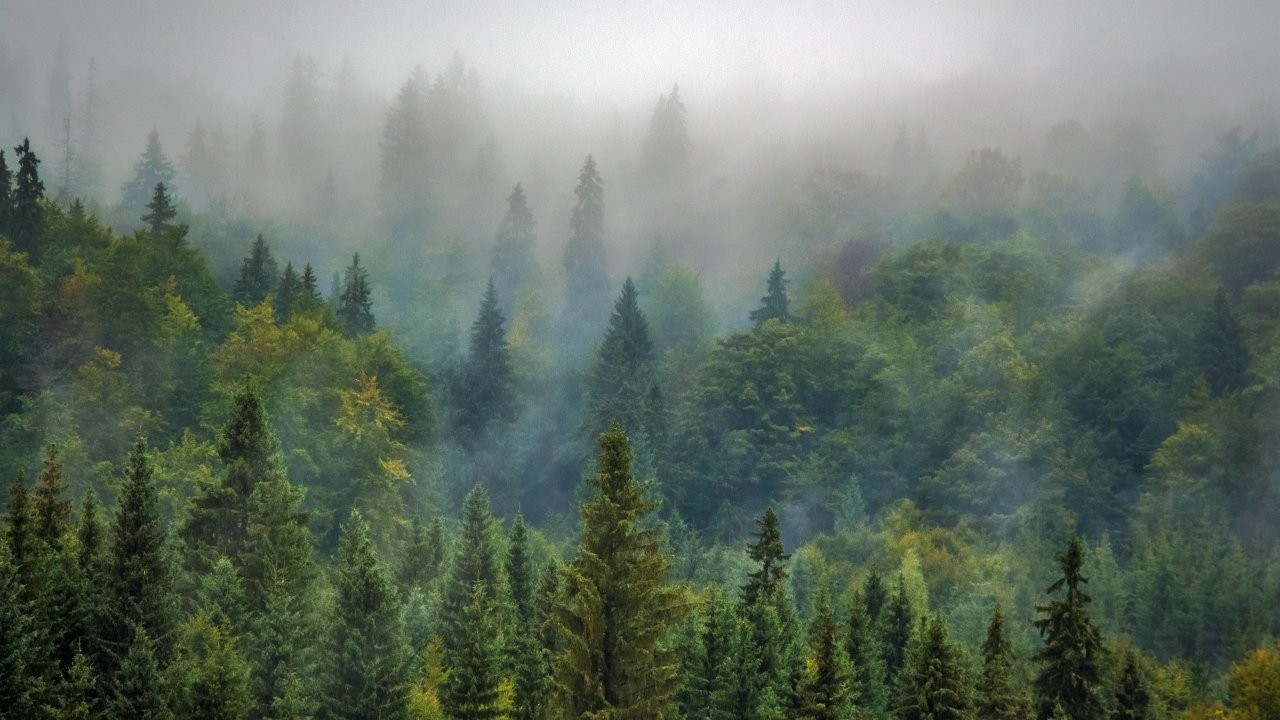
What does Forest Management do to secure the regeneration of the forest shown in Figure 1?
First, it divides the forest land into compartments (or periodic blocks), one for each distinct age class. The compartment containing the oldest age class (trees over 100 years old) is set aside as a biodiversity conservation zone.
A total renewal plan is then applied to the other four compartments, to be executed over the next 100 years. To achieve this, every 25 years, the oldest compartment (aged 75 to 100 years) is designated as the regeneration block.
This means that for 25 years, regeneration cuts will be carried out in this compartment using the "uniform shelterwood system" to open gaps in the canopy, allowing new saplings (the offspring of the surrounding trees) to establish themselves and grow.
It is called a uniform shelterwood system because, over a 25-year period, successive, uniform cuts are made to gradually open up clearings in the regeneration compartment. Meanwhile, in the other three compartments, thinning cuts are applied to adjust tree density to their age. This maintains their vigor and strength, preventing them from growing in overstocked conditions that would significantly weaken them.
After these first 25 years, the regeneration compartment will contain young trees aged between 0 and 25 years (at which point the stand is considered regenerated), while the remaining compartments will have aged by 25 years.
This shelterwood harvesting process is repeated every 25 years in whichever compartment is the oldest at the time, until regeneration cuts have been applied to all four compartments, as shown in the following diagrams, where the first frame represents the "parent forest":
After 100 years, a completely new forest has been established—a descendant of the parent forest shown in the first frame. This is achieved by applying uniform shelterwood regeneration cuts over 25 years in each compartment, while managing the density of the remaining compartments through thinning.


The timber harvested from each of these cuts generates enough revenue to finance subsequent operations, thereby self-funding the forest's regeneration plan.
It is highly inadvisable to apply regeneration cuts to excessively old forest stands. Extremely old trees have a significantly reduced capacity to produce seeds, and the germination rate of those seeds also declines. Leaving the future of a forest in the hands of overmature stands is highly reckless.
When well-meaning individuals oppose the harvesting of trees in a managed forest, in the vast majority of cases, they are unwittingly contributing to the amputation of that forest's future. They are also driving its abandonment—the precursor to devastating wildfires, which are the particular hell of Spanish forests.
But as we all know, the road to hell is paved with good intentions.