La ciencia que se asegura de la descendencia de los bosques

Jesús Alcanda Vergara, ingeniero forestal en el área de Energía de Sacyr Agua, explica en este artículo cómo hay que tratar de manera correcta la gestión de un bosque para asegurar su mantenimiento y regeneración arborícola.

Jesús Alcanda Vergara

Sacyr Energía


La opinión pública piensa con candidez, como en una interminable noche de Reyes Magos, que los bosques españoles ni nacen, ni crecen, ni mueren: solo permanecen. Que no precisan de ayuda humana para asegurar su descendencia; que siempre van a estar ahí, salvo que sean devorados por los incendios estivales.

En la península ibérica, la Dasonomía, la ciencia que trata del cuidado y manejo de los bosques, es más antigua que el emperador Trajano. De ello dejó constancia el escritor gaditano Columela, en el siglo I, tanto en “Los doce libros de agricultura (De Re Rustica)” como en “De arboribus”. 
Así como la Agronomía es la ciencia del “agro” (el campo), la Dasonomía es la ciencia del “Daso”, es decir, del bosque.

Como casi todas las ciencias, la Dasonomía ha ido ampliando el campo de sus certezas, desglosándose en diferentes especialidades. Del conjunto de disciplinas que forman parte de la Dasonomía, hay dos, la Selvicultura y la Dasocracia, que han experimentado una gran ordenación del conocimiento desde mediados de siglo XIX hasta finales del siglo XX. Precisamente, estas dos disciplinas son las encargadas de lograr que los bosques tengan descendencia.

La Dasocracia (“Daso”, bosque; y “cracia”, poder en sentido de gobierno, de orden) es la disciplina que trata de la ordenación de los bosques, de los montes: se trata de un conjunto de técnicas que lo ordenan para asegurar su descendencia.

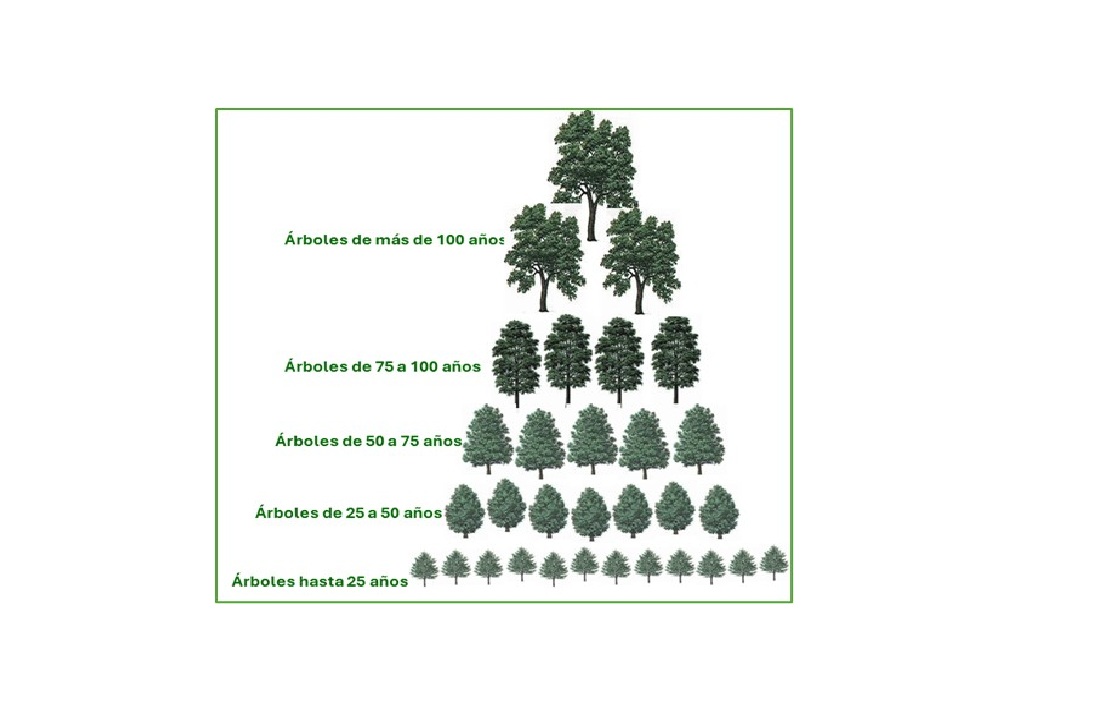
El manojo de técnicas analíticas de la Dasocracia conduce el bosque hacia una pirámide poblacional equilibrada. Es decir, sin truncar, sin inversiones, de forma que contenga todas las clases de edad del arbolado, distribuidas de tal forma que evidencien ese equilibrio y pueda afirmarse que el bosque está ordenado.

La otra muleta de la Dasonomía, la Selvicultura, es al bosque lo que la agricultura es al campo: un conjunto de cuidados y actuaciones que procuran la máxima vitalidad, la densidad adecuada y la defensa de la masa arbolada.

Cada clase de edad (ej.: de 25 a 50 años) debe estar representada por un número determinado de árboles en un determinado tramo. Es decir, para cada clase de edad existe una densidad de arbolado adecuada, representada por un rango de ejemplares por hectárea que las prácticas de la Selvicultura han de conseguir para que vivan con la máxima fortaleza y vigor posibles.


¿Qué hace la Dasocracia para lograr la descendencia del bosque representado en la Ilustración 1? 


Primero, divide el monte en tramos, uno para cada clase de edad diferenciada. El tramo de mayor clase de edad (árboles mayores de 100 años) lo reservará para zonas de conservación de la biodiversidad.

A los otros cuatro tramos les aplicará un plan de renovación total a ejecutar en los siguientes 100 años: para ello, cada 25 años se señalará el tramo de mayor edad (de 75 a 100 años) como tramo en regeneración.

Esto quiere decir que durante 25 años se aplicarán en este tramo cortas de regeneración por “aclareo sucesivo uniforme” (en adelante, ASU) con el fin de abrir huecos en el bosque donde nazcan y se asienten los nuevos arbolillos (hijos de los árboles circundantes).

Se llama así, ASU, porque durante 25 años se suceden cortas uniformes que abren claros en el tramo en regeneración: poco a poco. Durante este periodo, en los otros tres tramos se aplicarán cortas para adecuar la densidad del arbolado a su edad, para mantenerlos con el mayor vigor y fortaleza posibles, evitando que crezcan en una espesura excesiva que los debilitaría notoriamente.

Pasados estos primeros 25 años, el tramo en regeneración contendrá árboles cuya edad estará comprendida entre 0 y 25 años (y se dice que el tramo se ha regenerado) y el resto de tramos habrá incrementado su edad en 25 años.

Se repite el proceso de aplicación de cortas por ASU cada 25 años al tramo que en cada momento tenga mayor edad, hasta que hayamos aplicado las cortas de regeneración a los cuatro tramos, como se indica en las siguientes ilustraciones, cuyo primer cuadro representa al “bosque padre”:


Han transcurrido 100 años y se ha conseguido un bosque totalmente nuevo, hijo del bosque padre que figuraba en el primer cuadro, mediante la aplicación de las cortas de regeneración por aclareo sucesivo uniforme durante 25 años en cada tramo, mientras en los tramos restantes se adecuaba la densidad del arbolado a su edad mediante cortas por claras. 

La madera de cada una de estas cortas produce los suficientes ingresos para ir financiando las sucesivas cortas, para asegurar así la financiación del plan de descendencia del bosque.

No es recomendable aplicar cortas de regeneración a tramos del bosque excesivamente viejos, porque los árboles con mucha edad han menguado su capacidad de producir semillas y también ha disminuido la capacidad germinativa de sus semillas. Dejar la descendencia de un bosque en manos de tramos de monte excesivamente viejos es una auténtica temeridad.

Cuando alguien, con toda su “buena intención” se opone a las cortas de árboles en un bosque, en la inmensa mayoría de los casos está colaborando con la amputación de la descendencia de ese bosque, y también a su abandono, que es la antesala del gran incendio, ese particular infierno de los bosques españoles. 

Pero ya se sabe que el infierno está empedrado de buenas intenciones. 

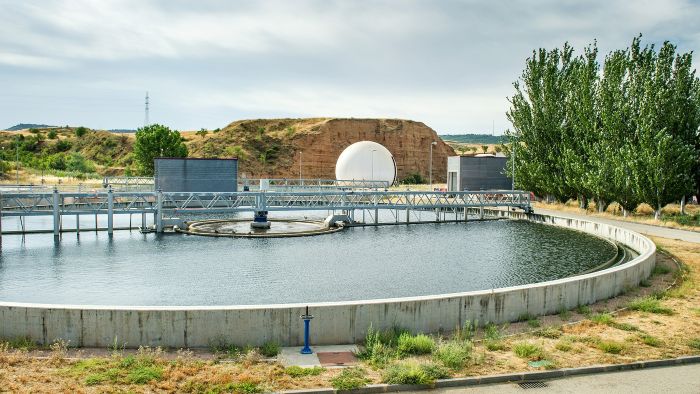
EDAR Guadalajara

EDAR Guadalajara donde se ha realizado la prueba piloto.

Innovation to remove nitrogen in wastewater

Our Denitox project develops a technology that consumes less energy and less organic matter during nitrogen removal in high-load streams in wastewater.

Nitrogen pollution in wastewater is an increasingly prevalent environmental challenge due to industrial, urban, and agricultural activities. Conventional nitrogen removal processes require intensive energy and a sufficient amount of organic matter that is not always available. 

To improve this process and make it more efficient, we are innovating with the Denitox project, which we are developing together with the University of Granada.

"With Denitox, we managed to reduce nitrogen by up to 80% and save energy by up to 50%," explains Elena Campos, head of Technical Support for Sacyr Agua's Treatment Area.

The nitrogen present in surface water bodies can promote uncontrolled algae growth, which can lead to high fish mortality, as has happened in the Mar Menor.


More restrictive European directive


The new European Wastewater Treatment Directive (TARU) drastically reduces the limits of nitrogen in discharge, which in many cases implies a real technological challenge. 

The runoff stream in plants with anaerobic sludge digestion can reach up to 20% of the total nitrogen load that reaches the plant and needs to be retreated after removal. Hence the importance of treating these return streams that have a high nitrogen content, but a low organic matter content. 

With our Denitox technology we can achieve lower nitrogen emissions in the discharge, with high polluting potential, economic savings and the reduction of greenhouse gas emissions.


Pilot test


"We have carried out a pilot test in the Guadalajara treatment plant, which was applied to the return stream of the sludge line, which has a lot of nitrogen. If wastewater normally has between 60 and 80 mg per liter, that stream has 500-1,000 mg per liter. In this study, which was carried out with real water and variable conditions, an 80% reduction was achieved in a stable way," explains Elena.

"Now, the main challenge is to maintain these high efficiencies at room temperature and shorter hydraulic retention times. If we manage to bring it to an industrial scale, Denitox would be a competitive solution for wastewater treatment applicable in many treatment plants to meet nitrogen removal targets," concludes Elena Campos.

Before this test, a stopover was made in the laboratory at the University of Granada, with which we have developed this technology.

"We have optimized the operating conditions, but we need to scale up to a larger size and see how to control the conditions well.


International award in Saudi Arabia


Recently, the Denitox project has won the Global Prize for Innovation in Water (GPIW), organized by the Saudi Water Agency, in the Sustainable Water Production and Environmental Conservation category.

This category values the balance in water supply with the protection of the ecosystem and the reduction of emissions.

Sacyr completes Vanderbilt Beach Road Extension in Florida (U.S.)

  • Sacyr Engineering and Infrastructure has delivered an 11 km road section representing an investment of $159 million (€137 million).
  • This is the company’s thirteenth infrastructure construction project completed in the United States.

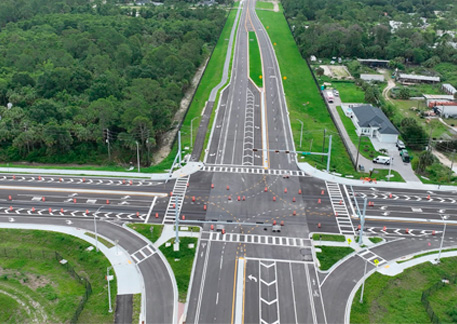
Sacyr has completed construction of the Vanderbilt Beach Road extension in Florida (United States). The 11 km road section, comprising 9.4 km of new construction and 1.6 km of extension of the existing road, was completed two months ahead of contract schedule and had a budget of $159 million (€137 million).

The new corridor, which opened to traffic on June 12, strengthens connectivity and mobility in southwest Florida and supports the region’s urban and economic development.

With Vanderbilt Beach Road, Sacyr has now delivered 13 road projects in the U.S.: nine in Florida and four in Texas.


Sustainable and resilient infrastructure

The Vanderbilt Beach Road extension is a strategic project to improve connectivity and mobility in Collier County, creating new road infrastructure that strengthens the east-west connection in one of Florida’s fastest-growing areas.

The project included the construction of bridge structures and drainage systems designed to meet stringent hydraulic and environmental standards, as well as the coordination and relocation of utilities to support the corridor’s development. It also included paving, lighting, signage and safety systems.

The completion of this project demonstrates Sacyr’s ability to deliver complex infrastructure projects in the U.S. market, driven by innovation and teamwork.

Commitment to infrastructure development in the U.S.

Sacyr began operating in the U.S. in 2018 and has since been awarded 16 projects in the country.

In 2024, Sacyr, as part of Calcasieu Bridge Partners consortium, was awarded its first major transport infrastructure concession contract in the United States: a section of the I-10 highway in Louisiana. The project will require an investment of €3 billion, of which just over €2 billion corresponds to construction.

As part of the objectives set out in its 2024-2027 Strategic Plan, the company will expand its activity in strategic English-speaking markets, including the U.S., Canada, the UK, Ireland and Australia.

0 Folders
4 Documents
María Jesús de Jaén Beltrá

María Jesús de Jaén Beltrá

DIRECTOR

Kind:

Independent

Professional and biographical profile:

Education: Degree in Economics from the University of Alicante and MBA from the University of Houston (USA). She has outstanding certifications, such as the European Financial Advisor (EFA) Certificate, the Expert Certificate in Climate and Renewable Energy Finance by Frankfurt School of Finance & Management GGMBH, the Executive Program in Fintech and Digital Banking by AFI, the COSO Certificate in Internal Control by the AMERICAN INSTITUTE of CPAs and the Certificate of Best Practices in Corporate Governance by the Institute of Directors and Administrators (ICA).

Experience: María Jesús de Jaén has an outstanding track record, with more than 24 years of experience in the international banking sector, mainly in the risk area. She has worked for 16 years in the Santander Group and 8 years in Bankia, in key areas such as Credit Risk, Market Risk and Risk Management in general.

Her subsequent role was Risk Management Consultant at the Green Climate Fund (GCF), a United Nations-created fund for sustainable investments in developing countries based in South Korea.

Currently, she is an Independent Financial/Investment and Risk Consultant, focused on the assessment of project finance transactions from financial, investment and risk criteria. In addition, she works with clients in defining target markets for project finance, specializing in a sustainable "green" economy linked to climate change, providing technical support for structuring, financing and providing financial/investment advisory services.


Date of appointment:

First appointment: June 7, 2018

Last reelection: June 4, 2026

José Joaquín Güell Ampuero

José Joaquín Güell Ampuero

Director

Kind:

Independent

Professional and biographical profile:

Education: Degree in Economics from Harvard (USA) and in Political Science from Sciences Po (Paris, France).

Experience: José Joaquín Güell has extensive experience in investment banking (at Lazard as Managing Director, Santander Investment and Merrill Lynch) in business management (as CFO and Managing Director of Grupo Recoletos) and in financial investment (Investindustrial). He is currently Chairperson of Somos Experiences, a marketing agency specialising in event organisation and Senior Member of the Industrial Advisory Board of Investindustrial.

He has been involved in national and international mergers and acquisitions for more than 20 years and has an extensive background in corporate management and financial advisory, as well as in financial and capital markets.


Date of appointment :

First appointment: June 7, 2018

Last reelection: June 4, 2026

Demetrio Carceller Arce

Demetrio Carceller Arce

1ST VICE-CHAIRMAN

Kind:

Proprietary (as proposed by Disa Corporación Petrolífera, S.A.)

Professional and biographical profile:

Education: Degree in Business Administration from the Colegio Universitario de Estudios Financieros, CUNEF of the Universidad Complutense de Madrid. Subsequently, he completed an MBA at Duke University, Fuqua School of Business (North Carolina, USA).

Experience: Demetrio Carceller Arce is 1st Vice-Chairman of the Board of Directors since 2011. He has a relevant role in the food and beverage, infrastructure, services and energy businesses, being Executive Chairman of the brewery group Damm, of Corporación Petrolífera Disa and Vice-Chairman of the food multinational Ebro Foods. Demetrio Carceller has previously held board positions in companies such as Freixenet, Deóleo, Gas Natural, Cepsa, CLH, Hidroeléctrica del Cantábrico, Gas Asturias and Syocsa-Inarsa.

He currently collaborates actively with Duke University, Fuqua School of Business, being a member of the Board of Visitors and with CUNEF, being a member of the Advisory Board.

In the philanthropic field, Demestrio Carceller Arce is Chairman of the Damm Foundation, an entity whose mission is to structure and disseminate Damm's sponsorship and philanthropic activities in the sports, social and cultural fields, is a member of the board of trustees of the Disa Foundation and the SERES Foundation and is a member of the Board of Trustees of the Teatro Real Foundation.


Date of appointment:

First Board Member appointment: January 29, 2003

Last reelection as director: June 4, 2026

Appointment as 1st Vice-chairman: October 20, 2011

Other boards of directors:

  • Vice-Chairman of Ebro Foods S.A.
  • Chief Executive Officer of Sociedad Anónima DAMM.
  • Chairman of Disa Corporación Petrolifera, S.A.
  • Chief Executive Officer of Corporación Económica Delta, S.A.

This website uses its own and third-party cookies to improve the user experience and analyze their behavior in order to improve the service offered.
You can consult additional information about the cookies installed on our Cookies policy.

Cookie Settings

Cookie declaration

TECHNIQUES

These cookies are exempt from compliance with article 22.2 of the LSSI in accordance with the recommendations indicated by the European authority on privacy and cookies. In accordance with the above and although configuration, acceptance or denial is not possible, the editor of this website offers information about them in an exercise of transparency with the user.

  • Name: LFR_Session_STATE_*, Provider: Liferay, Purpose: Manages the session as a registered user , Expiration: Session, Type: HTTP

  • Name: GUEST_LANGUAGE_ID, Provider: Liferay, Purpose: Determines the language with which you access , to show the same in the next session, Expiration: 1 year, Type: HTTP

  • Name: ANONYMOUS_USER_ID, Provider: Liferay, Purpose: Manages the session as an unregistered user , Expiration: 1 year, Type: HTTP

  • Name: COOKIE_SUPPORT, Provider: Liferay, Purpose: Identifies that the use of cookies for the operation of the portal, Expiration: 1 year, Type: HTTP

  • Name: JSessionID, Provider: Liferay, Purpose: Manages login and indicates who is using the site, Expiry: Session, Type: HTTP

  • Name: SACYRGDPR, Supplier: Sacyr, Purpose: Used to manage the cookie policy , Expiration: Session, Type: HTTP