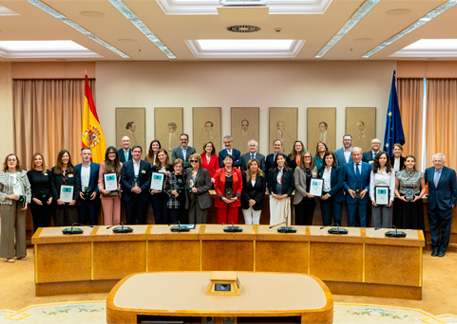
Sacyr has received the Excellence in Compliance and Diversity Award at the ninth Diversity and Inclusion Awards. Presented by Fundación Adecco and Club de Excelencia en Sostenibilidad, the award recognizes the company’s efforts to integrate its diversity strategy across all its business areas and operations in more than 15 countries.
Teresa Manjón, Sacyr’s Director of Labor Relations and Diversity, accepted the award at a ceremony held today at Spain’s Congress of Deputies. The award recognizes the company’s comprehensive diversity, equity, and inclusion (DEI) management system, which goes beyond legal requirements to make diversity a strategic pillar of its business, sustainability, and governance.
Through this system, Sacyr tracks more than 250 indicators and runs dedicated programs focused on equality, disability inclusion, age inclusion, work-life balance, and inclusive leadership, involving employees across the organization.
Organized by Fundación Adecco and Club de Excelencia en Sostenibilidad, the awards recognize companies that make the most of people’s talents by integrating diversity and inclusion into their corporate strategies, driving positive change both within their organizations and in the wider community.
“Diversity makes us a better, more competitive company, better prepared for the future,” said Teresa Manjón as she accepted the award.

Teresa Manjón, Sacyr’s Director of Labor Relations and Diversity.
Enrique Sánchez, President of Fundación Adecco, opened the awards ceremony, noting: “Through high-impact projects, the winning companies have shown how they boost business competitiveness and advance human and social development.”
Also speaking at the opening was Juan Alfaro, Secretary General of Club de Excelencia en Sostenibilidad, who said: “Year after year, we see organizations of all sizes taking an increasingly strategic approach to embedding these policies, benefiting both people and business performance.”
Judging panel
Under the honorary presidency of Their Majesties the King and Queen of Spain, the judging panel comprised Mercedes Fernández, Chair of the Committee on Comprehensive Disability Policies at Spain’s Congress of Deputies; Íñigo Sagardoy, President of Sagardoy Abogados; Carmen Alsina, Director of Communications, Institutional Relations, and Sustainability at CEOE; Juan Alfaro, Secretary General of Club de Excelencia en Sostenibilidad; and Pablo García, a member of the operating committee of Alianza #CEOPorLaDiversidad.