SacyrNewsSacyr secures $460 million financial close of Antofagasta water reuse facility in Chile
Share:
Sacyr secures $460 million financial close of Antofagasta water reuse facility in Chile
The operation, backed by Banco Estado, BTG Pactual and Banco Internacional, marks the first of this scale for a water reuse infrastructure project.
The Antofagasta facility will be Latin America's largest, significantly enhancing Chile's water security through sustainable, innovative, and impactful infrastructure
27/04/2026
Sacyr Water has successfully reached financial close of the Salar del Carmen water reuse plant in Antofagasta, Chile, for $460 million. The term of the concession is 35 years.
The financing has been subscribed by Banco Estado, BTG Pactual and Banco Internacional and represents a historic milestone due to the important technical complexities involved in the structuring of a water reuse project of this scale.
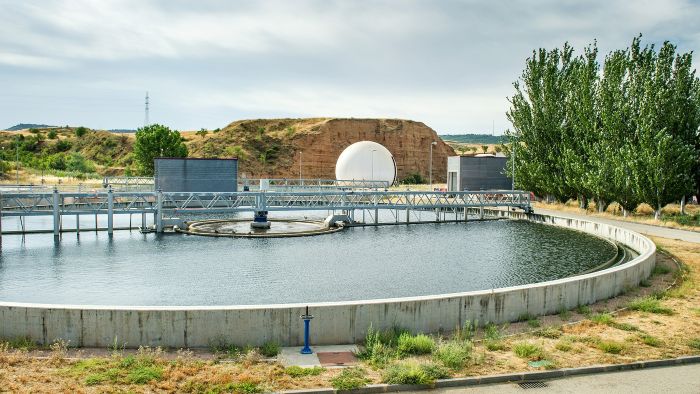
The plant, tendered by Chile’s Sanitary Services Company (Econssa), will be the largest in Latin America and will focus on reuse water for the mining industry. It will substantially improve regional sustainability indices and create more than 500 jobs in the area.
"With this operation, Sacyr reaffirms its commitment to the development of sustainable, innovative and high-impact infrastructures, contributing to water security, care for the environment and improving people's quality of life. This concession will mark a pioneering trend in wastewater reuse", said Sacyr Water's manager in Chile, Lucas de Marcos.
Salar del Carmen Plant
The plant will capture pre-treated wastewater from the current Antofagasta plant, operated by Sacyr Water, and will take it to the Salar del Carmen area, where the new treatment plant will be located, which will have a final capacity of 900 liters per second.
It is expected that the pretreated waters will be transported along 16 kilometers, to the Salar del Carmen sector, including a 5.4-kilometer section in the urban area that will be executed by microtunneling.
In addition, an additional 24 kilometers will be built to La Negra and another 24 kilometers to Mantos Blancos. The new treatment plant is expected to be operational in 2028.
Sacyr has been in Chile since 1996 and has developed projects in its three key areas: Concessions, Engineering and Infrastructure, and Water. Currently, it operates five airports, 11 concessioned routes, seven hospitals in different stages of development and five sanitation facilities that cover the integrated water cycle.
In addition, Sacyr Water has the concession contract for the design, financing, construction and operation of the new Coquimbo desalination plant, the first desalination plant for human consumption in the Coquimbo region.
With activities in 14 of Chile’s 16 regions, Sacyr creates more than 4,100 direct jobs and is committed to sustainable development and the well-being of communities.
Info:The document preview may not show all pages. Download it to see the full document.
0 Folders
4 Documents
SacyrNewsSix Volunteers Bring Sacyr's Talent and Engineering to Mauritania
Share:
Six Volunteers Bring Sacyr's Talent and Engineering to Mauritania
A group of six Sacyr professionals traveled to Bir Moghrein (Mauritania) on the second trip organized by the Sacyr Foundation to collaborate on infrastructure development.
23/04/2026
Six Sacyr professionals participated in an international volunteer program organized by the Sacyr Foundation in collaboration with the NGO UPlanet.
Paco Molina, Iván Roselló, Camila Quintín, Eva Abad, Lucía Cecilia, and Ana Grande spent a week in Bir Moghrein, an isolated village in northern Mauritania. The expedition also included Rubén Fernández, Ana Grande's son, along with a group of 30 healthcare professionals from HumanCoop, four members of UPlanet, and a professional from Viamed, Rodrigo Morilla, a former Sacyr colleague.
This marks the second edition of the volunteer program in Mauritania, which aims for Sacyr professionals to help repair and develop infrastructure that impacts the lives of the local population.
Among the projects they collaborated on, a highlight was the repair of deficiencies in the village's desalination plant to improve water production and quality. Additionally, the necessary technical documentation was created for the installation of a new containerized desalination plant, which is scheduled to arrive in the summer.
The electrical system of the health center was also renovated, a project to install new latrines in the primary school was developed, and progress was made on a one-hectare garden project to provide food for the population and create employment for women.
Finally, an entrepreneurship workshop was organized to boost the local economy among women.
A tough but rewarding experience
"On a personal level, it has been an incredible experience; it grounds you and gives you a lot of perspective on life. Professionally, it has been rewarding to be able to make my small contribution through this wonderful profession," explains Camila Quintín (Sacyr Engineering and Infrastructure).
Paco Molina and Iván Roselló, both from Sacyr Water, collaborated on improving the desalination plant's facilities. They adjusted water quality by implementing a mixing system with filtered water to extend the life of the membranes. They also created a bypass for the filter backwash water.
Paco Molina states that it is a trip "worth repeating." "It has been a tough yet kind, disheartening yet enriching, selfish yet selfless experience – a mix of contrasting feelings, but always with a positive balance," he adds.
"We have bridged gaps through effort and collaboration," affirms Iván Roselló.
"Our group created a balanced ecosystem in a remote and inhospitable place. A reality check that puts my concept of 'life' into perspective," says Eva Abad (Sacyr Proyecta).
Ana Grande (Sacyr Holding) emphasizes that this volunteering experience is a "challenge overcome." "I applied engineering outside of my comfort zone, engaged in teamwork, and gained real learning. It has been an experience that adds value professionally and personally, thanks to the people with whom I shared this adventure," remarks Ana.
"It has been a tough but very rewarding experience at the same time. Helping these people who have so little gives you another perspective on life and what is truly important, which is helping each other. I value the human warmth of my colleagues," explains Lucía Cecilia (Sacyr Holding).
Rubén Fernández, in charge of the electrical tasks, stated that "the lack of technical materials made work difficult at the clinic, but with effort and improvisation, we managed to get our job done." He adds, "It has been a different and tough experience, but I have learned so much about how fortunate we are to live in a country like ours and the ease we have in Europe of drinking tap water and finding whatever you need in any store."
Collaboration with UPlanet
The collaboration between the Sacyr Foundation and UPlanet is fundamental for integrating infrastructure in this underdeveloped region, isolated by a vast desert expanse. UPlanet, in turn, collaborates with HumanCoop, which organizes medical-surgical missions to the country, thereby creating synergies in organizing all logistics.
The next initiative we will collaborate on will be the installation of a new portable containerized desalination plant, which will arrive in Bir Moghrein in the summer.
"Our collaboration with UPlanet helps us reach these remote areas, where, thanks to our help, they can count on experts in infrastructure and water who collaborate to improve the facilities of these communities," explains Pedro Alonso, Director of the Sacyr Foundation.
"International volunteer programs help our professionals step outside their usual scope of work and grow as individuals," he explains.
"At UPlanet, we believe that community development hinges on improving basic infrastructure, which allows for laying the foundations of sustainable development. Thanks to the collaboration and contribution of the Sacyr Foundation, the actions carried out in agriculture, water, and sanitation have been a success. They have immeasurable value," explains Matías Fernández, Presidente of UPlanet, a former colleague from Sacyr Water, and coordinator of the field mission conducted in Bir Moghrein.
SacyrNewsFinal stretch for the TBM at the Barcelona Metro
Share:
Gran Vía TBM launching shaft.
Final stretch for the TBM at the Barcelona Metro
The tunnel boring machine (TBM) destined to excavate the new section of Barcelona Metro's Line 8 is currently undergoing its final rigorous testing. It's now being prepared to begin its journey through the city's subsoil this summer, ultimately carving out nearly four kilometers of new tunnel to revolutionize mobility in the Catalan capital.
10/03/2026
This ambitious Barcelona Metro Line 8 extension will introduce four kilometers of new track, three new stations (Gràcia, Clínic, and Francesc Macià), and include a significant upgrade to the existing Espanya station. The Joint Venture (JV) awarded the project comprises Sacyr (27.5%), Ferrovial (27.5%), Copcisa (22.5%), and Copisa (22.5%).
The TBM, a critical component for this expansion, is presently in Sant Boi, where it's undergoing its conclusive tests.
“We are conducting thorough inspections, testing all components, software, automation, and mechanical functions to guarantee flawless operation before relocating it to the Gran Vía launching shaft,” explains Toni Julià, the JV's Construction Manager.
Later this month, the TBM's various components will commence their transfer to the launching shaft, marking the precise location where excavation will begin. This powerful machine is expected to remove over 300,000 cubic meters of earth.
The excavated material will be transported from Joan Miró Park via an auxiliary micro-tunnel constructed beneath Llançà Street. From there, a dedicated conveyor belt system will transfer the spoil to waiting trucks for disposal at a landfill.
“The launching shaft is progressing very well: the front section is being prepared with the base slab for TBM assembly, while the rear is being configured for its connection with the micro-tunnel. We are also erecting an acoustic enclosure to mitigate noise during the boring operations,” Juliá adds.
Even as the TBM assembly advances, other critical construction activities are in full swing.
At the Hospital Clínic and Francesc Macià station sites, hydrofraise trench cutters are actively constructing diaphragm walls that will reach an impressive depth of 82 meters. These are set to be the deepest ever built in Spain.
These robust diaphragm walls are essential; they will enable the safe excavation of the shafts through which the TBM will pass and, subsequently, facilitate the construction of the underground caverns designed to house the station platforms.
Key Highlights of this Major Infrastructure Project
“With an anticipated 19 million annual users, this project represents one of the most socially and economically beneficial undertakings within the Generalitat's Infrastructure Master Plan,” Toni Julià emphasizes.
The L8 extension will seamlessly connect Barcelona's two primary railway networks—Baix Llobregat and Vallès—managed by FGC. This integration is poised to significantly enhance intermodality and overall city-wide mobility. The project carries a budget of €322 million and is scheduled for completion within 61 months.
This website uses its own and third-party cookies to improve the user experience and analyze their behavior in order to improve the service offered.
You can consult additional information about the cookies installed on our Cookies policy.
These cookies are exempt from compliance with article 22.2 of the LSSI in accordance with the recommendations indicated by the European authority on privacy and cookies. In accordance with the above and although configuration, acceptance or denial is not possible, the editor of this website offers information about them in an exercise of transparency with the user.
Name: LFR_Session_STATE_*, Provider: Liferay, Purpose: Manages the session as a registered user , Expiration: Session, Type: HTTP
Name: GUEST_LANGUAGE_ID, Provider: Liferay, Purpose: Determines the language with which you access , to show the same in the next session, Expiration: 1 year, Type: HTTP
Name: ANONYMOUS_USER_ID, Provider: Liferay, Purpose: Manages the session as an unregistered user , Expiration: 1 year, Type: HTTP
Name: COOKIE_SUPPORT, Provider: Liferay, Purpose: Identifies that the use of cookies for the operation of the portal, Expiration: 1 year, Type: HTTP
Name: JSessionID, Provider: Liferay, Purpose: Manages login and indicates who is using the site, Expiry: Session, Type: HTTP
Name: SACYRGDPR, Supplier: Sacyr, Purpose: Used to manage the cookie policy , Expiration: Session, Type: HTTP
ANALYTICS
These cookies allow us to count visits and sources of circulation in order to measure and improve the performance of our site. They help us know which pages are the most or least popular, and see how many people visit the site. All the information collected by these cookies is aggregated and, therefore, anonymous.
Name: _ga_<container-id>, Provider: Google, Purpose: Collects data about the number of times a user has visited the website in addition to the dates of the first and most recent visit. Used by Google Analytics, Expiration: 2 years Type: HTTP
Name: _ga, Provider: Google, Purpose: Registers a unique ID that is used to generate statistical data about how the visitor uses the website, Expiration: 2 years Type: HTTP