Las Setas de Sevilla takes center stage in the fourth episode of the series in which we review the landmark projects from our 40-year history. The episode explores the construction and management of this concession, which has transformed the area surrounding the Plaza de la Encarnación in Seville, Spain.
Opened in 2011, Las Setas have become an international icon of Seville over the past 15 years. Its 3,500 wooden slats form the world’s largest wooden structure, internationally recognized for its innovation.
Antonio Belmonte, Mariano Peláez, and Leticia Franco, professionals at Sacyr, recount the technical and human challenges involved in its construction and the work that made this project possible.
Their accounts explain how advanced engineering and cutting-edge architecture were combined with integration into the city’s urban and social environment.
The episode also explores the present and future of the concession and the management of Sacyr Concesiones, 15 years after its inception. The complex houses a museum, a food market, an observation deck, and a cultural center, and serves as a gathering place for residents and visitors alike.
- P3 Projects
Seville's Mushrooms, Our Most Special Asset
In 2011, we inaugurated a unique landmark, Las Setas de Sevilla, a monument that has captivated millions of visitors. In our review of Sacyr’s major projects over the past 40 years, Las Setas has earned a place on the list due to its technical complexity and enormous impact on the city.
Sacyr improves its sustainability ratings with S&P Global and MSCI ESG
- The company ranks among the most sustainable businesses in its sector worldwide, with sustainability embedded in its strategy.
Sacyr ranks among the most sustainable companies in its sector worldwide, according to the latest assessments by S&P Global and MSCI, which recognize the company’s strong performance and its integration of sustainability into its strategy.
The company scored 77 out of 100 in S&P Global’s Corporate Sustainability Assessment (CSA), up one point from 2025 and 26% higher than in its first assessment in 2021.
Sacyr’s MSCI ESG rating also improved from A to AA.
These results reflect the progress Sacyr has made in embedding sustainability in its strategy and its commitment to making a positive impact throughout its value chain.
Stronger sustainability performance
Sacyr’s score in S&P Global’s CSA places it among the top-performing companies in its sector worldwide and recognizes its strong practices in key areas including business ethics, environmental management, innovation, and transparency.
The upgrade to an AA rating from MSCI also highlights Sacyr’s ability to manage its most significant environmental, social, and governance (ESG) risks and opportunities, supported by strong governance and well-established, effective policies, procedures, and controls.
These assessments recognize the company’s ability to create sustainable, long-term value by embedding sustainability throughout its business model. This approach strengthens its resilience and competitiveness and helps it respond to stakeholder expectations.
These results reinforce Sacyr’s commitment to transparency and continuous improvement as it pursues sustainable growth that creates shared value for shareholders, clients, employees, partners, and society as a whole.
Sacyr Sustainable Roadmap 2024–2027
These milestones underscore Sacyr’s commitment to sustainability and the strength of its Sacyr Sustainable Roadmap 2024–2027, which focuses on four key pillars: planet, people, prosperity, and governance.
These pillars are supported by three drivers that cut across all four areas: culture, innovation, and sustainable finance. Sacyr has set specific targets and actions for each area to maximize the positive impact of its activities.
Sacyr also has a Sustainable Financing Framework covering green and social financing, as well as financing linked to the achievement of sustainability targets.
The company continues to build a more responsible business by developing its climate change strategy, maximizing its positive impact on society, and working to strengthen its position as an employer of choice.

Sacyr wins Excellence in compliance and diversity award at the ninth Diversity and inclusion awards
- The awards recognize companies’ efforts to manage workplace diversity, develop policies that promote equity and equal opportunity, and promote social inclusion and access to employment.
- The award recognizes Sacyr’s comprehensive management system, which makes diversity a strategic pillar of its business, sustainability, and governance.
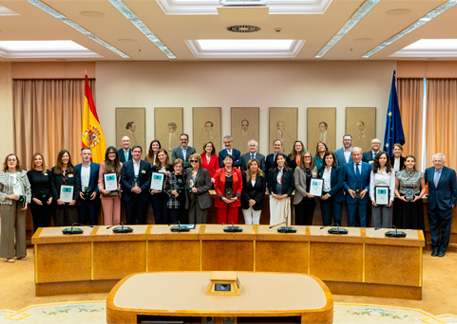
Sacyr has received the Excellence in Compliance and Diversity Award at the ninth Diversity and Inclusion Awards. Presented by Fundación Adecco and Club de Excelencia en Sostenibilidad, the award recognizes the company’s efforts to integrate its diversity strategy across all its business areas and operations in more than 15 countries.
Teresa Manjón, Sacyr’s Director of Labor Relations and Diversity, accepted the award at a ceremony held today at Spain’s Congress of Deputies. The award recognizes the company’s comprehensive diversity, equity, and inclusion (DEI) management system, which goes beyond legal requirements to make diversity a strategic pillar of its business, sustainability, and governance.
Through this system, Sacyr tracks more than 250 indicators and runs dedicated programs focused on equality, disability inclusion, age inclusion, work-life balance, and inclusive leadership, involving employees across the organization.
Organized by Fundación Adecco and Club de Excelencia en Sostenibilidad, the awards recognize companies that make the most of people’s talents by integrating diversity and inclusion into their corporate strategies, driving positive change both within their organizations and in the wider community.
“Diversity makes us a better, more competitive company, better prepared for the future,” said Teresa Manjón as she accepted the award.

Teresa Manjón, Sacyr’s Director of Labor Relations and Diversity.
Enrique Sánchez, President of Fundación Adecco, opened the awards ceremony, noting: “Through high-impact projects, the winning companies have shown how they boost business competitiveness and advance human and social development.”
Also speaking at the opening was Juan Alfaro, Secretary General of Club de Excelencia en Sostenibilidad, who said: “Year after year, we see organizations of all sizes taking an increasingly strategic approach to embedding these policies, benefiting both people and business performance.”
Judging panel
Under the honorary presidency of Their Majesties the King and Queen of Spain, the judging panel comprised Mercedes Fernández, Chair of the Committee on Comprehensive Disability Policies at Spain’s Congress of Deputies; Íñigo Sagardoy, President of Sagardoy Abogados; Carmen Alsina, Director of Communications, Institutional Relations, and Sustainability at CEOE; Juan Alfaro, Secretary General of Club de Excelencia en Sostenibilidad; and Pablo García, a member of the operating committee of Alianza #CEOPorLaDiversidad.

- Corporate
Announcement: Release of 9M 2026 Results
SACYR, S.A. announces call notice of the Group’s 9M 2026 results presentation.

The results will be released on Tuesday, November 3rd, 2026, after market close in CNMV and in our website.
The results presentation will be held on Wednesday, November 4th, 2026, at 12:00h (CET) by audio-webcast in real time, accessible via this link.
Access to the presentation of results replay will also be available directly at the link above.