Nitrogen pollution in wastewater is an increasingly prevalent environmental challenge due to industrial, urban, and agricultural activities. Conventional nitrogen removal processes require intensive energy and a sufficient amount of organic matter that is not always available.
To improve this process and make it more efficient, we are innovating with the Denitox project, which we are developing together with the University of Granada.
"With Denitox, we managed to reduce nitrogen by up to 80% and save energy by up to 50%," explains Elena Campos, head of Technical Support for Sacyr Agua's Treatment Area.
The nitrogen present in surface water bodies can promote uncontrolled algae growth, which can lead to high fish mortality, as has happened in the Mar Menor.

More restrictive European directive
The new European Wastewater Treatment Directive (TARU) drastically reduces the limits of nitrogen in discharge, which in many cases implies a real technological challenge.
The runoff stream in plants with anaerobic sludge digestion can reach up to 20% of the total nitrogen load that reaches the plant and needs to be retreated after removal. Hence the importance of treating these return streams that have a high nitrogen content, but a low organic matter content.
With our Denitox technology we can achieve lower nitrogen emissions in the discharge, with high polluting potential, economic savings and the reduction of greenhouse gas emissions.

Pilot test
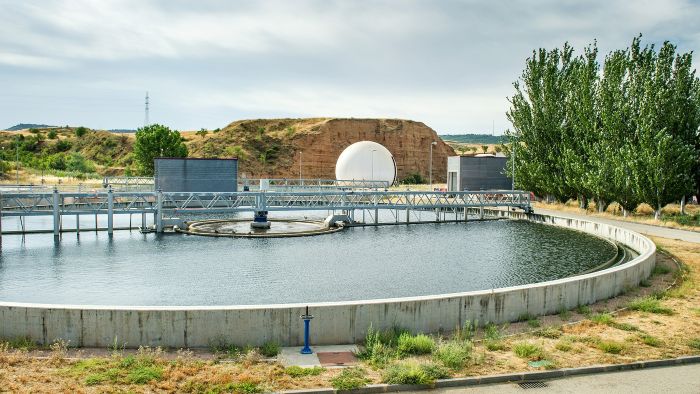
"We have carried out a pilot test in the Guadalajara treatment plant, which was applied to the return stream of the sludge line, which has a lot of nitrogen. If wastewater normally has between 60 and 80 mg per liter, that stream has 500-1,000 mg per liter. In this study, which was carried out with real water and variable conditions, an 80% reduction was achieved in a stable way," explains Elena.
"Now, the main challenge is to maintain these high efficiencies at room temperature and shorter hydraulic retention times. If we manage to bring it to an industrial scale, Denitox would be a competitive solution for wastewater treatment applicable in many treatment plants to meet nitrogen removal targets," concludes Elena Campos.
Before this test, a stopover was made in the laboratory at the University of Granada, with which we have developed this technology.
"We have optimized the operating conditions, but we need to scale up to a larger size and see how to control the conditions well.

International award in Saudi Arabia
Recently, the Denitox project has won the Global Prize for Innovation in Water (GPIW), organized by the Saudi Water Agency, in the Sustainable Water Production and Environmental Conservation category.
This category values the balance in water supply with the protection of the ecosystem and the reduction of emissions.