Jesús Alcanda Vergara
Sacyr Energy
One of Spain's largest forest restoration projects, if not the largest, has a story worth telling. It took place on the edge of the desert, in the arid lands of Murcia, and is known as the "Hydrological and Forest Restoration of Sierra Espuña."
Back in the third quarter of the 19th century, Sierra Espuña was an utterly desolate landscape.
First, in 1748, the Spanish Royal Navy seized the timber rights to its forests on the pretext of rebuilding the country's naval power. The local population lost its communal use of the land, and the forests became a target for speculation.
Later came the great sell-offs of municipal land (the desamortizaciones) to shrewd profiteers. Starting in the 1830s and continuing for the next fifty years, they led to the entire sierra being clear-cut so that the buyers could cash in on their purchases right away.
Finally, what scrub and brush remained was burned for charcoal, the only livelihood left to these plundered villages.
This cycle of exploitation left Sierra Espuña a barren landscape of stony ground and bare earth, home only to lizards, where every now and then a famished goat could be seen searching for blades of grass among the stones and rocks.
With no forests to protect them, the valleys of this part of the Segura River basin were hit by a catastrophic flood in October 1879, which claimed more than 700 lives and left ruin and devastation in its wake.
In 1885, the Congress against the Floods of Levante was held. Out of it came the Segura Basin Reforestation Commission, made up of the engineers José Musso, Ricardo Codorniú and Juan Ángel de Madariaga.
They decided to begin the restoration in Sierra Espuña, in the upper basin of the Guadalentín River, whose valleys had suffered the highest death toll.
Musso, Codorniú and De Madariaga pioneered the colossal task of restoring the forests of Sierra Espuña, which began as soon as the Commission was formed.

First, they surveyed the entire sierra on foot, divided the work areas into perimeters and drew up a restoration project for each one.
Millions of trees (pines, holm oaks, Portuguese oaks, poplars…) were to be sown and planted. The main obstacle was the lack of soil for them to take root in: Espuña was then a stony sierra.
For this reason, more than 900 dry-stone check dams (built without mortar) were erected in the ravines and torrents to hold the soil on the slopes of the sierra. The slopes were also "stitched" with 135 linear km of small walls (40–80 cm) that trapped and built up soil, making planting easier later on.
Carrying out this work required designing and building more than 180 km of forest roads and tracks, backed up by more than 200 km of paths (for moving plants, animals, farm implements and all kinds of tools and equipment across the steep terrain).
Bridges, shelters, forest houses, sheepfolds and stables were built, along with facilities for the draft animals (mules, mares, oxen…) and provisions for their care and feeding. So was housing of every kind for the army of workers that such a colossal undertaking demanded: laborers and farmhands, muleteers, mare keepers, mule drivers, ox herders, sowers, reapers, watchmen, tool keepers and foremen, water carriers, forest guards, engineers and assistants, and so on.
While all this was going on, the nurseries, well distributed across the sierra, successfully turned out between half a million and a million and a half plants a year (less than four growing seasons old, bare-root or potted). Millions of pine nuts and holm oak and Portuguese oak acorns were gathered as well…
A true feat in a climate that averaged barely 400 liters of rain per square meter a year. When it did rain, it did so grudgingly.
In 1891, the reforestation work began, and it soon became clear that shallow tilling for sowing did not work on such poor, sterile soil.
Sowing gave way to planting saplings, bare-root or potted. The ground was first worked with heavy plows reinforced with extra shares to cut deeper, as teams of powerful mules and oxen turned over the rough earth to the loud creaking of their yokes.
The days were endless. When they finally drew to a close and the sun spilled across the horizon, everyone headed back to the camps and shelters, amid hardship and deprivation, with weariness in their eyes and bread soup for supper.
Long lines of mares, mules and oxen came back with them in silence, wrapped in a cloud of steam and flanked by their equally silent muleteers. All walked at a slow, almost tragic pace, weighed down by weariness and solitude.
The months went by in a blur. By 1924, after years of work, 5,000 hectares of what had once been a sea of sand and thirst had been successfully replanted.
Building on the work done on these slopes and ravines, the engineers who followed expanded the hydrological and forest restoration effort until, by 1945, 17,000 hectares had been replanted.
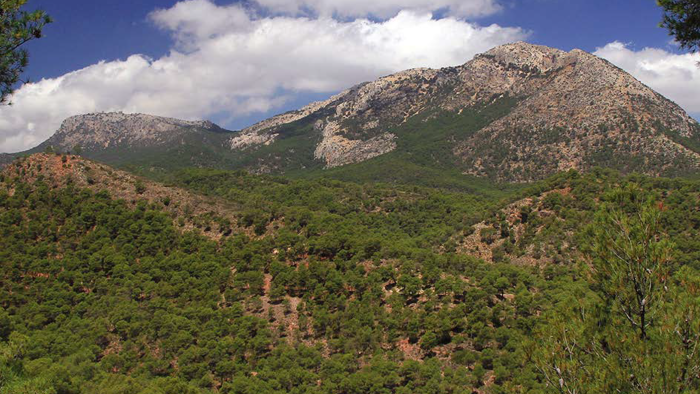
The stripped sierra is a thing of the past, and today a colossal forest covers the ravines and slopes of Sierra Espuña. It was declared a "Natural Site of National Interest" in 1931 and a "Natural Park" in 1978.
In 1992 it became Sierra Espuña Regional Park, the highest level of protection a natural area can have in the Region of Murcia.
In this century, it has also been added to the Natura 2000 Network as both a Site of Community Importance and a Special Protection Area for Birds.
Its vegetation has become so rich that today the park is home to 915 species of vascular flora, which support 200 species of vertebrate fauna, along with 10 endemic invertebrates: one endemic to the Iberian Peninsula and the rest to southeastern Spain.
In short, it is a true testament to humankind's ability to restore ecosystems laid waste by the mistakes of history. Together with neighboring Sierra de Burete, Espuña forms a gigantic barrier that holds back the advance of the desert in southeastern Spain and protects its fields and villages from floods and flash floods.
The patience sown by the pioneers of this monumental effort taught their successors that, when working with the land, you have to know how to wait and never give up. The miraculous forests of Sierra Espuña are living proof.