With this project, which we completed in December 2023, we overcame a particularly demanding challenge—not only because of the hospital’s size, but also because of the tight construction schedule of just 26 months. Throughout the construction process, we had to navigate extraordinary circumstances such as the COVID-19 pandemic, a transportation strike, and the war in Ukraine.
Together with two of the key figures involved—Pedro Gallego, Director of Hospital Construction, and Pedro Luis Rodríguez, Site Manager—we look back on the challenges, the teamwork, and the dedication of our professionals who made this major project possible.
The 12 de Octubre Hospital is the sixth flagship project in our series on Sacyr’s 40th anniversary, which we began in January with the Los Vilos-La Serena highway in Chile.
We invite you to discover it in this new video.
- Infrastructures
12 de Octubre Hospital: A Leading Medical Center Built in Record Time
We continue to celebrate our 40th anniversary with a series of videos in which we look back at some of our most iconic projects. Today, we take a look back at the construction of the new 12 de Octubre Hospital in Madrid, a leading healthcare facility in Spain with 41 operating rooms and more than 1,300 beds.
Other regulatory bodies
This section includes the public information submitted to other regulatory bodies, In case it differs from that prepared under legal precepts.
The Canal de Isabel II awards Sacyr Water and Ocide the conservation and maintenance of Torrelaguna's sanitation networks
- The contract includes the maintenance of more than 660 km of sanitation networks.
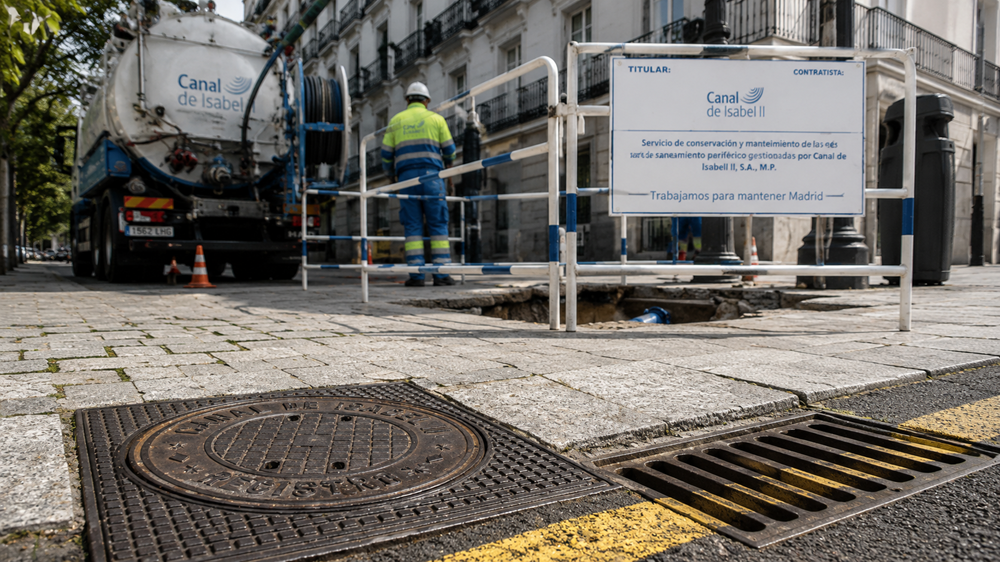
Canal de Isabel II has awarded the consortium formed by Sacyr Agua (60%) and Ocide Construcción (40%) the contract to undertake carry out the conservation and maintenance services of the peripheral sanitation networks of Torrelaguna (lot 8) for an amount of €11 million and a period of 48 months.
The contract includes cleaning, inspection, operation, conservation and improvement of the networks of the Canal de Isabel II in the Torrelaguna area, in northeast Madrid. Among other municipalities, it includes Paracuellos del Jarama, Ajalvir, Cobeña, Algete, Fuente el Saz and Daganzo de Arriba, which have a population of more than 100,000 people.
The objective of the contract is to guarantee the proper hydraulic operation of the system and to extend the useful life of infrastructures essential for the well-being of citizens and for the protection of the environment.
Within the contract, the consortium will carry out the conservation of more than 660 kilometers of sanitation networks, a strategic infrastructure that includes sewerage, collectors, outfalls, scuppers, manholes, drainage systems and discharge points. In addition, it will invest in machinery, suction and impulsion equipment and network inspection and surveillance.
This type of service plays a fundamental role in sustainable water management and in the prevention of problems due to heavy rainfall.

- Infrastructures
10 Years Since the Expansion of the Panama Canal: Sacyr and a Giant Whose Success Lies in the Details
A team of 10,000 people built one of the greatest structures in human history with millimeter-level precision.

The Panama Canal expansion has marked its 10th anniversary. With the benefit of hindsight, we can reaffirm the success of this mega-construction project, which placed Sacyr and its professionals at the international forefront of engineering and civil construction.
The Third Set of Locks, a unique and truly innovative project, has operated optimally during its first decade, despite its unprecedented complexity. Behind this achievement is the highly qualified team of 10,000 workers representing 40 nationalities who made it a reality.
The expansion once again placed the Canal at the center of global trade. Three percent of maritime trade passes through this strategic waterway: it connects 180 routes, 170 countries, and 1,920 ports around the world.
The Panama Canal Expansion in 60 Seconds
The Third Set of Locks not only increased the number of ships that can pass through the Canal but also allowed the passage of the imposing, larger Neo-Panamax vessels: 366 m in length, 49 m in beam, and a draft of 15.2 m.
These giants are also more sustainable than smaller ships, since carrying much more cargo results in lower energy consumption and a significant reduction in greenhouse gas emissions.
The expansion itself was also designed and developed with strict sustainability criteria in mind: it is capable of reusing up to 60% of the water in each lock passage and reducing the water required for its operation by 7%.

A colossal project…
The new locks of the Panama Canal are one of the largest man-made structures in history: they are 427 meters long, 55 meters wide, and 18.3 meters deep.
To put their magnitude into perspective with a few figures, the volume of structural concrete poured on site for the Pacific and Atlantic locks reached 4.5 million cubic meters—the equivalent of 2.2 Pyramids of Cheops.

The reinforced steel totaled 250,000 metric tons—the weight of 25 Eiffel Towers.
And 62 million m³ of earth were moved, equivalent to the load of 2.6 million dump trucks.
The 16 gates of the Third Set of Locks are one of the project’s most notable features: they were built and transported from Trieste, Italy, on a journey that lasted one month.
The logistics and the precise positioning of these gates represented one of the most exciting and spectacular milestones of the project. There are six different models, and the heaviest ones, weighing 3,900 metric tons, have colossal dimensions: 57 meters long, 10 meters wide, and 32 meters high.
… success lies in the details
Paradoxically, on a project of such gigantic proportions as this one, success lies in the smallest details; every piece must fit together with the precision of a Swiss watch.
The finishes required perfect precision to ensure maximum watertightness and efficiency. For example, all concrete surfaces—totaling 280,000 square meters—were meticulously sanded to minimize water resistance. The clearances at the sealing edges of the gates and their recesses were measured in microns.
This approach—treating a massive project with the precision of a goldsmith—was key to the success and durability of the Panama Canal expansion, a legacy left by Sacyr and its partners for the progress of humanity.
Sacyr formalizes win of Ruta Pie de Monte road concession in Chile
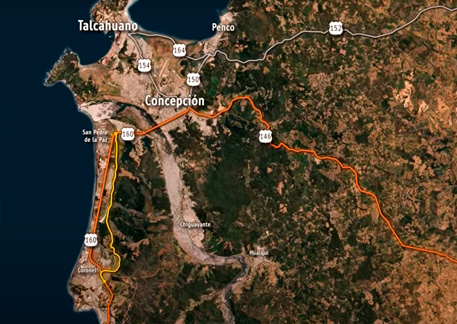
- La concesión incluye la construcción, operación y mantención de una ruta de 20 kilómetros en doble calzada entre San Pedro de la Paz y Coronel.
- El proyecto forma parte del plan de modernización vial impulsado por el MOP en la Región del Biobío y permitirá generar una alternativa a la actual Ruta 160.
Chile’s Official Gazette (Diario Oficial) has published the Supreme Decree awarding Sacyr the Ruta Pie de Monte road concession. This strategic project in the central Biobío Region will improve connectivity across Greater Concepción and enhance access to the Arauco Province.
With an estimated investment budget of UF 9,145,000 (approximately €330 million), the new 20-kilometer dual-carriageway highway will run between San Pedro de la Paz and Coronel, to the east of the existing Route 160. Total revenues expected over the concession period will amount to €3.8 billion.
The project features state-of-the-art infrastructure, including lighting, drainage and drainage works, landscaping, road safety features, and a free-flow electronic tolling system to ensure faster and safer travel for motorists. Additionally, the highway incorporates tsunami evacuation routes, upgrading safety and connectivity standards for both commuters and local communities.
This new corridor will serve as a vital alternative to Route 160, which has faced heavy traffic congestion in recent years due to rapid urban and population growth in the area.
Consequently, the Ruta Pie de Monte will reduce travel times, enhance road safety, optimize traffic flow, and boost regional economic competitiveness, particularly benefiting freight transport and long-distance travel.