María Gómez Bravo | Tungsteno
In their search for more space, cities first reached skyward. Skyscrapers and landmark towers reshaped skylines and often became symbols of major capitals. Yet a quieter revolution was also taking place underground. It began with a practical aim: moving the infrastructure that keeps a city running beneath its streets. First came sewers and water mains, followed by railways, subway lines, utility cables, parking garages, and even roads.
As land at the surface becomes scarcer, the space below is increasingly valuable. Every new tunnel, cable or facility must fit among the infrastructure already there without blocking what future projects may require. Yet pressure on surface land is only part of the story. Geology, climate, and other local conditions also shape the way cities develop underground.
A City Carved Out of Rock
The granite bedrock beneath much of Helsinki has helped shape the city’s underground development. For decades, it has been excavated to create tunnels, parking garages, energy facilities, and sports venues. Helsinki has made systematic use of its distinctive geology since the 1960s. By the time it began drafting its first dedicated underground plan, around nine million cubic meters of rock had already been excavated for some 400 facilities and tunnels.
Many of these spaces have a dual role. In everyday life, underground facilities house swimming pools, sports centers, and other recreational spaces carved out of the bedrock. In an emergency, they can also serve as civil defense shelters. Shared tunnels carry district-heating and cooling pipes, high-voltage power cables, and telecommunications networks, which together extended for around 300 kilometers when the plan was drawn up.

The underground swimming pool in Itäkeskus is located in bedrock 50 meters below the surface, inside one of Helsinki’s civil defense shelters that has been adapted for everyday use. Credit: ALESSANDRO RAMPAZZO/AFP via Getty Images.
As demand for underground space grew, Helsinki had to consider not only where to build new facilities, but also which parts of the bedrock should be left untouched for future use. The result was the Underground Resources and Master Plan, which mapped existing and planned caverns, facilities, and tunnels, while reserving space for long-term projects. The first plan identified 40 new areas as rock reserves and more than 100 sites for future construction. Ilkka Vähäaho, who headed Helsinki’s geotechnical division for many years, has explained that the rapid expansion of underground construction since the beginning of this century has made it increasingly necessary to manage where excavation takes place.
Helsinki’s first underground plan put it simply: bedrock can be excavated only once. Buildings can be replaced and plots of land repurposed, but caverns carved into the rock are permanent and may obstruct future infrastructure. Helsinki therefore began planning not only what to build underground, but also the empty space that would need to remain available.
A Shield Against Winter
In Montreal, Canada, winter shapes not only how people get around, but also how they use the city. Beneath its streets, a network of pedestrian walkways links offices, universities, hotels, shopping centers, and other buildings without requiring people to step outside. Used by about 500,000 people a day, this underground city allows residents and visitors to travel across much of downtown sheltered from the cold.
Yet the nearly 32 kilometers of walkways that make up RÉSO, Montreal’s underground pedestrian network, were not originally built as a response to the climate. The network began to take shape around Place Ville Marie between 1962 and 1967, expanding alongside major downtown property developments and the growing metro system, particularly in the years leading up to Expo 67.

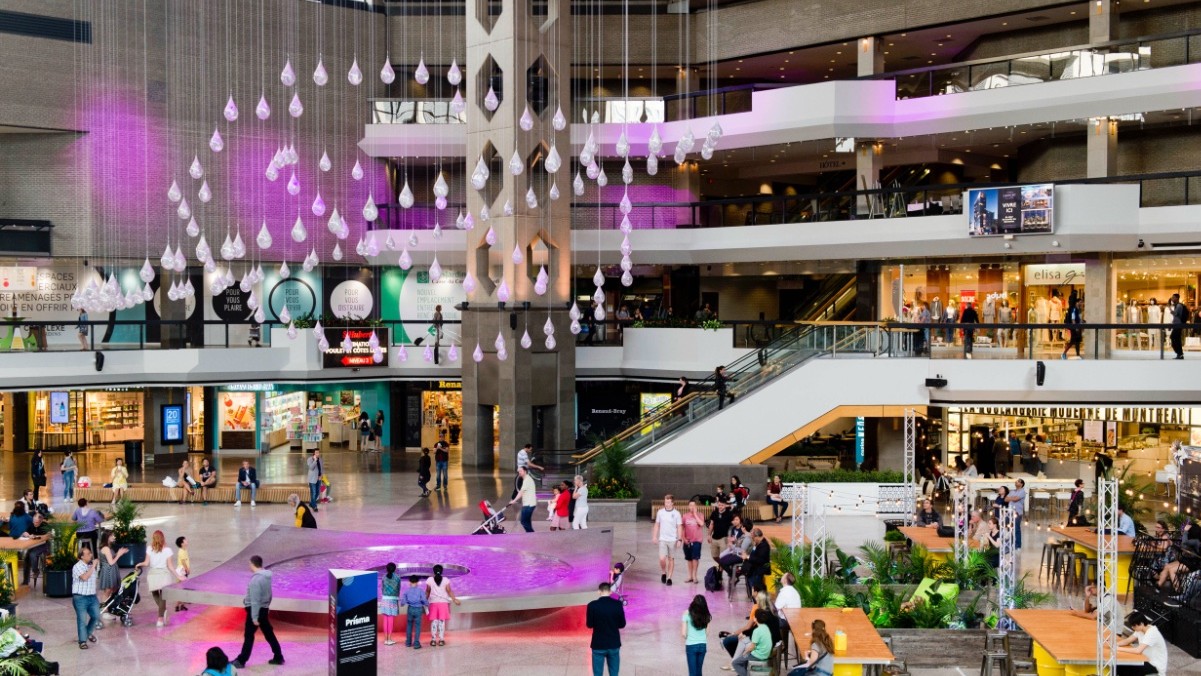
The Montreal Trust shopping center is part of RÉSO, the underground network that connects buildings, stores, hotels, and metro stations in downtown Montreal via nearly 32 kilometers of walkways. Credit: Pascal QUITTEMELLE/Gamma-Rapho via Getty Images.
There was no single master plan. Instead, connections were added over the decades as new buildings were incorporated into the system. This organic growth turned this underground network into an extraordinary asset for both the downtown economy and the everyday mobility of its residents during the coldest months. Today, RÉSO is so woven into the life of the city that it is hard to separate its economic role from its practical value as a way of getting around.
Cold weather does affect how people move around Montreal. A study by Luis F. Miranda-Moreno and Aleksiina Lahti found that outdoor pedestrian traffic declines in winter, with temperature, humidity, wind, and precipitation all influencing the decision to walk. Yet RÉSO has become so embedded in the workings of downtown that the weather outside makes surprisingly little difference to how residents use it.
An analysis by Professor John Zacharias on underground pedestrian trips in the city found that weather has no impact on the distance people walked or the proportion of the journey spent underground. The starting point mattered far more. What began as a series of separate connections has become part of the everyday experience of crossing downtown Montreal, regardless of the weather.
150 Meters Beneath Singapore
Beneath Jurong Island, off the coast of Singapore, five enormous caverns lie hidden about 150 meters below ground. The Jurong Rock Caverns can store up to 1.47 million cubic meters of liquid hydrocarbons for Singapore’s energy and chemical industries. Building them freed about 60 hectares at the surface for other industrial activities. In a country with a land area of just over 730 square kilometers, that is a significant gain.
For decades, Singapore has been waging a battle to create room in a city-state with little land to spare. It has reclaimed land from the sea, built upward, and increasingly looked below ground. Mining engineer Yingxin Zhou captured the idea vividly at the 2018 World Urban Forum: “Singapore doesn’t have gold, oil, or diamonds. But we mine something equally precious: space.”

In total, Singapore already has about 300 kilometers of tunnels and plans to add a further 60 kilometers over the next decade, according to the Master Plan 2025. Credit: John Seaton Callahan.
The Jurong Rock Caverns are perhaps the most spectacular manifestation of Singapore’s search for underground space, but much of this transformation remains out of sight. On the main island, the underground levels closest to the surface accommodate shops, parking garages, services, and pedestrian links. Deeper down are rail lines, roads, and networks for water, sewer, and electricity. In total, Singapore already has about 300 kilometers of tunnels and plans to add a further 60 kilometers over the next decade, according to the Master Plan 2025.
As Singapore has made increasing use of its subsurface, long-term planning has become necessary. In 2007, the government established a dedicated inter-agency task force. Three years later, underground development was incorporated into the country’s economic strategy, as Zhou and Jian Zhao describe in a study published in Tunnelling and Underground Space Technology. The Master Plan 2025 now explores new possibilities, from storage caverns and utility tunnels to energy infrastructure, while reserving room for future needs.
Creating space at the surface can also lead to costs underground. Subterranean spaces require lighting, ventilation, and often dehumidification. A study published in Sustainable Cities and Society also identified potential benefits associated with transportation, more compact land use, infrastructure, and geothermal energy. Depth alone does not make a project sustainable. What matters is what is moved underground, how much room that creates above ground, and how long the space can be put to good use.
Tungsteno is a journalistic laboratory that explores the essence of innovation.